Pakistan requires development-focused budget beyond short-term stabilization: IPS seminar
Pakistan’s upcoming federal budget must move beyond short-term economic stabilization and focus on long-term development priorities including export growth, investment promotion, food security, and reduction in poverty and inequality. Without political will, institutional coordination, structural reforms, and reliable economic data, the country may continue to face stagflation, widening inequality, and growing balance-of-payments pressures.
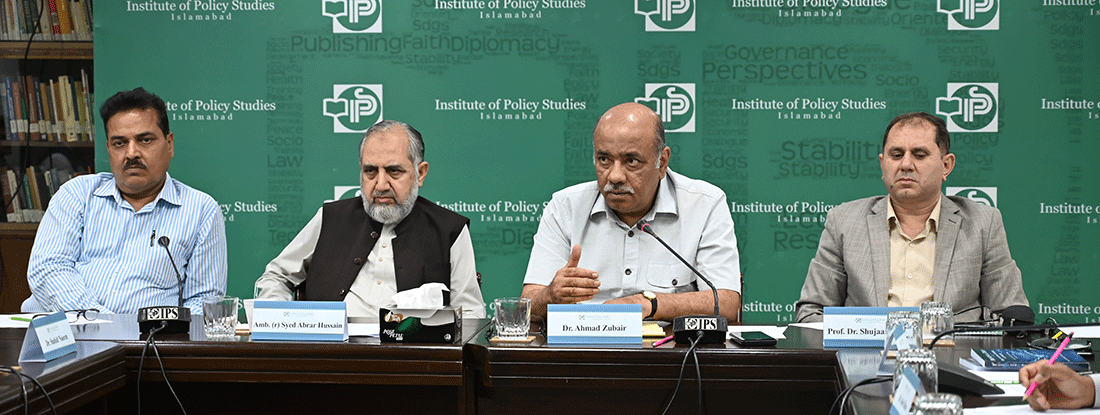
The aforementioned views were expressed by economists and fiscal experts during a discussion on the federal budget 2026-27 and Pakistan’s economic challenges organized by the Institute of Policy Studies (IPS), Islamabad, on May 19.
The session was chaired by Dr. Ahmad Zubair, former chief economist, while the speakers included Dr. Zafar ul Hasan Almas, former joint chief economist; Dr. Shahid Naeem, consultant, Ministry of Poverty Alleviation & Social Safety; Prof. Dr. Shujaat Farooq, dean research, PIDE; Mehtab Haider, economic journalist; and Qanit Khalil Ullah, chartered accountant and economist. The session was joined by Amb (r) Syed Abrar Hussain, vice chairman, IPS, and members of academia and practitioners from various sectors.
Presenting an overview of the economy, Dr. Zafar ul Hasan warned that rising imports of consumable goods and emerging food security concerns may contribute to higher food inflation in the coming months. He said inflation could reach 15 percent, increasing pressure on interest rates and debt servicing requirements in the next budget. He also highlighted serious issues regarding the availability and authenticity of economic data, which, according to him, continue to create fragmented policymaking and weak institutional coordination.
Dr. Shahid Naeem observed that despite improvements in growth indicators, poverty and inequality continue to rise due to elite capture and excessive indirect taxation. He noted that autonomous price-setting mechanisms have reduced the effectiveness of the budget process, while social protection programs remain poorly coordinated and fragmented. He added that lack of accountability and political pressure has weakened institutional performance and budgetary outcomes.
Discussing structural economic issues, Dr. Shujaat Farooq stated that annual budgets should be linked with long-term development planning, which currently remains neglected. He pointed to weak coordination between federal and provincial institutions and observed that revenue generation has increasingly overshadowed broader development goals.
Mehtab Haider said the salaried class continues to bear the main tax burden while wealthy sectors remain outside the effective tax net. He stressed that meaningful reforms require strong political will, documentation of the informal economy, and investment promotion.
In his concluding remarks, Dr. Ahmad Zubair emphasized the need for innovative development-oriented economic strategies to enhance per capita income and strengthen economic sovereignty. He maintained that weak governance remains the country’s central economic challenge despite substantial tax collection.