Modern challenges facing Muslim societies require paradigm shift in thinking: IPS discussion
The challenges posed by the modern industrial world to Muslim societies cannot be addressed through nostalgia for the past, piecemeal reforms, or resistance to change alone. Rather, they demand a fundamental transformation in intellectual outlook, institutional development, and approaches to governance and progress.
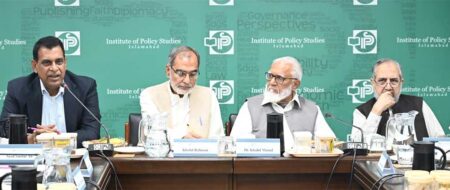
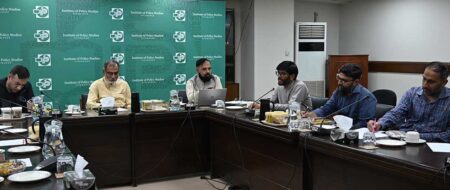
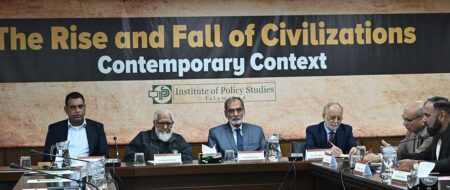
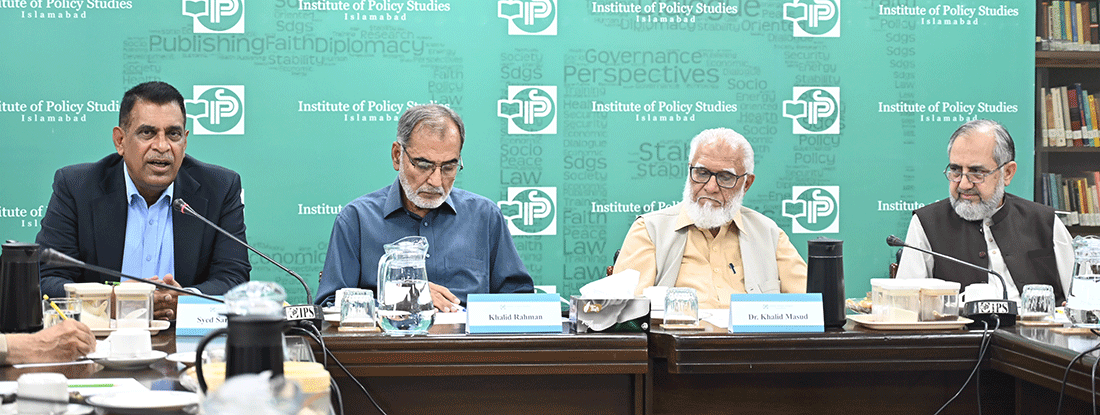
These views emerged during the third and last session of the discussion series titled “The Rise and Fall of Civilizations: Contemporary Context,” held at the Institute of Policy Studies (IPS) on May 6, 2026. This discussion was organized around the thesis work of Syed Sardar Ali, founder and chairman of Pakistan Crescent Foundation, regarding modernity, Islam, and Pakistan.
Discussing the role of reason in the evolution of modern societies, Sardar Ali noted that Europe’s shift toward empirical observation, experimentation, and scientific inquiry reshaped its political, economic, and social structures. He argued that the modern industrial world was fundamentally built upon rational inquiry and human agency rather than inherited traditions and dogma.
Addressing the relationship between Islam and modernity, he reflected on the historical tension between faith and reason in Muslim societies. He argued that while Muslim civilizations once benefited from the acquisition of Greek knowledge and intellectual traditions, they ultimately failed to establish a lasting synthesis between rational inquiry and orthodox religious thought. He also pointed to the Ottoman Empire’s inability to adequately respond to Europe’s modernization as a turning point in the decline of Muslim political power.
Participating in the discussion, Muhammad Noman Akram argued that reason and intellect are valuable tools encouraged by Islam, but they should not become superior to divine guidance. Building on this relationship between reason and faith, Dr. Sohaib Zafar of the Character Education Foundation emphasized the need to revisit the intellectual history of Muslim civilization and examine why the traditions of philosophical dialogue and scientific inquiry weakened over time. Dr. Waleed Rasool, research associate at IPS, argued that both reason and experience are essential sources of knowledge and maintained that Islam historically acted as a catalyst for scientific and intellectual development.
Adding a civilizational perspective to the debate, Prof. Jalil Aali observed that Muslim civilization historically differed from Christianity because it never developed a centralized papal authority, arguing that religion gradually evolves into broader cultural and civilizational forms shaped by collective historical experience.
Referring to South Asian political experiences, Dr. Nadeem Abbas of Al-Mustafa International University questioned the assumption that authoritarianism naturally produces modernization. Shifting the focus to individuals, Sardar Khalid emphasized that the decline of Muslim societies is not only civilizational but also deeply connected to corruption, dishonesty, weak civic responsibility, and moral decline at the individual level. He warned that unchecked materialism and destructive power could eventually threaten even modern Western civilization itself.
Alluding to moral responsibility, Mehrene Malik Adam argued that many social problems in Pakistan stem from a mindset that treats power as the ultimate source of truth and authority. Stressing personal accountability, she maintained that meaningful societal reform cannot occur unless individuals reform themselves and move beyond blame-oriented politics. With a focus on future generations, Nabeela Jafar emphasized that human beings are born with both rights and desires, which require moral regulation through divine guidance and constitutional principles.
Dr. Khalid Masud, member, Shariat Appellate Bench, Supreme Court of Pakistan, emphasized that discussions on civilizational progress should remain intellectually focused and include a serious comparative analysis of both Western and Islamic historical experiences.
Amb (r) Syed Abrar Hussain, vice chairman, IPS, appreciated the initiative to examine how Western societies progressed and what lessons Muslim societies can learn from them without unquestioningly imitating their mistakes. He argued that the rise and fall of civilizations depend not only on governance, economy, and military strength, but also fundamentally on moral and ethical values.
In his concluding remarks, Khalid Rahman, chairman of IPS, emphasized that societies should avoid overgeneralizing their weaknesses, as many positive initiatives and responsible individuals continue to contribute toward social betterment. He observed that the modern industrial West represented a historically unprecedented civilizational transformation rather than merely an advanced continuation of earlier societies.