Revitalizing Waqf and Zakat demands systemic reform, tech integration, and ethical economic frameworks: IPS & AIOU Conference
Revitalizing Islamic finance institutions Waqf and Zakat is to address socio-economic inequalities and development models; in Pakistan, effectiveness requires institutional reform, governance transparency, and technological integration for sustainable inclusive growth.
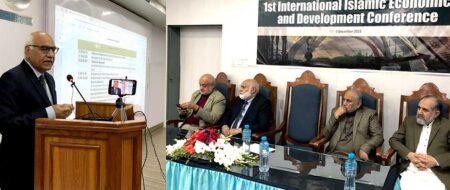
These themes emerged during the Professor Khurshid Ahmad International Conference 2026, jointly organized by the Institute of Policy Studies (IPS) and Allama Iqbal Open University (AIOU) on April 2-3, 2026, under the theme “Mobilizing Waqf and Zakat for Socio-Economic Empowerment: Policy Perspectives on Entrepreneurship and Sustainability.”
The conference brought together national and international scholars, policymakers, and practitioners to explore frameworks for strengthening Waqf and Zakat as structured instruments of sustainable development.
Speakers included Prof. Dr. Nasir Mehmood, VC AIOU; Prof. Dr. Anis Ahmad, VC RIU; Prof. Dr. Iqbal Khan, VC STMU; Prof. Dr. Mohyuddin Hashmi, dean, AIOU; Khalid Rahman, chairman IPS; Prof. Dr. Atiquzzafar Khan, STMU; Dr. Ghazala Ghalib, IIUI; Prof. Dr. Kabir Hassan, The University of New Orleans, USA; Omar Mustafa Ansari, secretary general, AAOIFI, Bahrain; Prof. Dr. Mehmet Asutay, Durham University, UK; Dr. Tariq Naseem, SECP; Dr. Toseef Azid, UMT; Dr. Fazal ur Rehman, Zakat Foundation of America; and Dr. Salman Syed Ali, former research lead, IsDB.
Deliberations highlighted that while Zakat and Waqf have historically ensured equitable wealth distribution, their role in the Subcontinent has weakened due to governance gaps, corruption, and limited regulatory effectiveness, undermining public trust, while reforms in Türkiye, Malaysia, and Indonesia show how financial technologies and institutional restructuring enhance transparency and efficiency.
Speakers emphasized that Islamic economic principles offer a holistic framework integrating social justice, moral values, and economic development, presenting Waqf and Zakat as instruments for restoring socio-economic balance and linking welfare with long-term empowerment through entrepreneurship, vocational training, and skill development.
Khalid Rahman noted that rising geopolitical tensions and economic uncertainties heighten the need for alternative development paradigms focused on social welfare and collective well-being, with Waqf and Zakat supporting reconstruction and development in post-crisis contexts through resource mobilization for peacebuilding.
On the second day, discussions focused on systemic reforms to unlock their untapped potential, noting that fragmented governance structures and siloed social protection systems continue to limit their impact on poverty alleviation.
Speaker included Prof. Dr. Tahir Mansoori, Shariah board member, Askari Islamic Bank; Dr. Shahid Naeem, consultant, Ministry of Poverty Alleviation and Social Safety; Dr. Khaleeq-uz-Zaman, chairman Inclusive Resource Management; Dr. Tariq Naseem, head Islamic finance SECP; Prof. Dr. Abdul Quddus Sohaib, BZU; Prof. Dr. Muhammad Ayub, RIU; Mufti Shakir Jakhura, senior manager AAOIFI, Bahrain; Prof. Dr. Abdulhamit Birisik, RIU; Dr. Hendri Tunjang and Dr. Yuki Rahmawati from Indonesia; Dr. Ibrahim Bulushi from Kenya; Dr. Muhammad Husam Helmi from the UAE; Ayaz Mehmood Lashari, Auqaf zonal administrator, Rawalpindi, Prof. Dr. Anwar Shah, IBA Karachi, Dr. Ali Salman, CEO Prime Institute; and Dr. Irum Saba, IBA Karachi.
The conference emphasized modern governance frameworks and innovative instruments such as Cash Waqf Linked Sukuk, along with blockchain and artificial intelligence to enhance transparency and trust.
The declaration called for a unified national Waqf authority, autonomous Zakat governance, and the role of Islamic banking institutions as intermediaries, while prioritizing technology-driven systems and development-oriented fund utilization.
Concluding the conference, Syed Abrar Hussain, vice chairman IPS, reiterated that a transparent, technology-enabled, and impact-driven system is essential to translate the potential of Waqf and Zakat into meaningful socio-economic outcomes in Pakistan.