Responsible AI Governance and Human Oversight Essential as Pakistan Navigates AI Shift: Experts
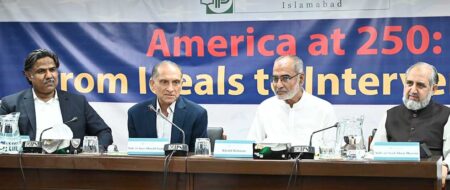
Pakistan needs responsible adoption of Artificial Intelligence (AI), supported by human oversight, institutional preparedness and appropriate policy safeguards, as AI continues to reshape decision-making, education, research, workplaces and public services, experts said at a seminar organized by the Institute of Policy Studies (IPS), Islamabad, on October 1, 2026.
Titled “Navigating the AI Shift: Opportunities, Risks, and Policy Directions,” the seminar explored the opportunities emerging from AI while examining concerns related to ethics, safety, governance and accountability.
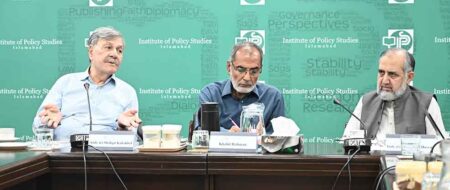
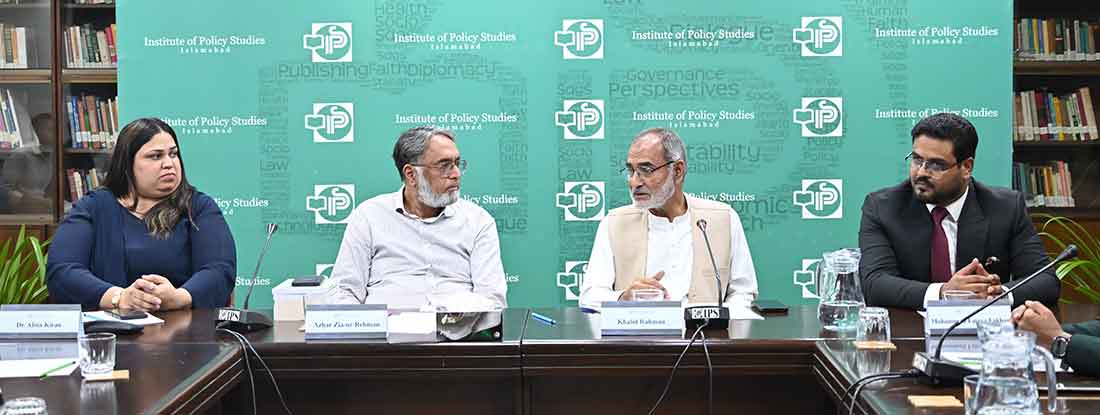
The speakers included Azhar Zia-ur-Rehman, an expert on AI governance and ethics; Faizan Fakhar, senior research associate, Centre for Aerospace and Security Studies; and Dr. Alina Kiran, assistant professor, Bahria University Islamabad. Khalid Rahman, chairman, IPS, chaired the session.
Delivering the keynote address, Azhar Zia-ur-Rehman said the transition towards AI requires responses at multiple levels, involving individuals, organizations, states and international institutions. He highlighted approaches including developing standards and guidelines, incorporating ethics into AI design, assessing risks and ethical maturity, auditing AI systems, regulating applications according to risk, and introducing stronger controls for high-risk uses.
He emphasized that AI governance should be treated as a governance challenge rather than merely a technological issue, with greater attention to data governance, institutional oversight and organizational responsibility. He also noted that AI is creating new professional fields in implementation, transformation, governance, auditing, ethics and AI-enabled work. Referring to Islamic ethical concepts including khilafah, amanah, adl, mizan, ilm, verification and responsibility, he discussed their relevance to responsible AI.
Speaking on AI safety, Faizan Fakhar identified misalignment, misuse and structural risk as key areas requiring attention. He explained that these risks range from AI systems acting beyond intended objectives and the deliberate exploitation of AI capabilities to broader consequences arising from rapid AI development and deployment. He called for continuous evaluation of AI systems in their actual deployment environments and supported international mechanisms to address risks associated with advanced AI.
Dr. Alina Kiran described AI as an organizational and societal transformation rather than solely a technological development. She highlighted potential applications in education, healthcare, public administration and universities, while stressing controlled testing, monitoring and evaluation before wider deployment.
She identified misinformation, inaccurate outputs, bias, privacy and data protection, cybersecurity, intellectual-property concerns, workforce disruption and excessive reliance on AI as issues requiring attention. She called for institutional policies covering AI use, disclosure, data protection, academic integrity, human oversight and accountability.
In his concluding remarks, Khalid Rahman said Pakistan has significant AI usage but remains comparatively less developed as a creator of AI technologies. He urged the country to actively engage with the transformation rather than remain a passive user. He also stressed that technological progress should remain grounded in values, ethics and accountability, warning that excessive dependence on AI could weaken human thinking, analytical capacity and critical judgment.