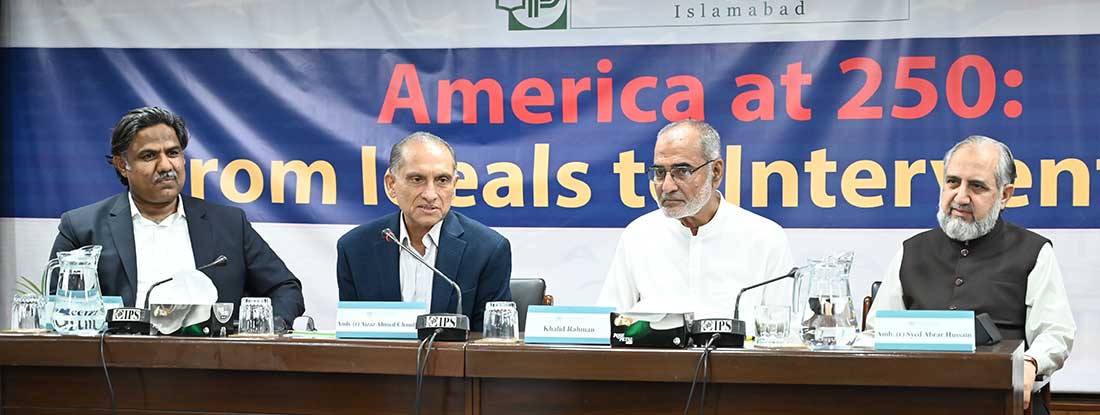
America’s enduring tension between founding ideals and interventionism continues to shape global order: IPS seminar
As the United States marks 250 years since its founding, the enduring tension between its constitutional ideals and interventionist foreign policy continues to influence both American statecraft and the evolving international order. While liberty, democracy, and constitutional governance remain central to the American identity, the country’s external conduct has increasingly reflected the primacy of national interests, raising important questions about the relationship between moral principles, pragmatism, and global leadership.
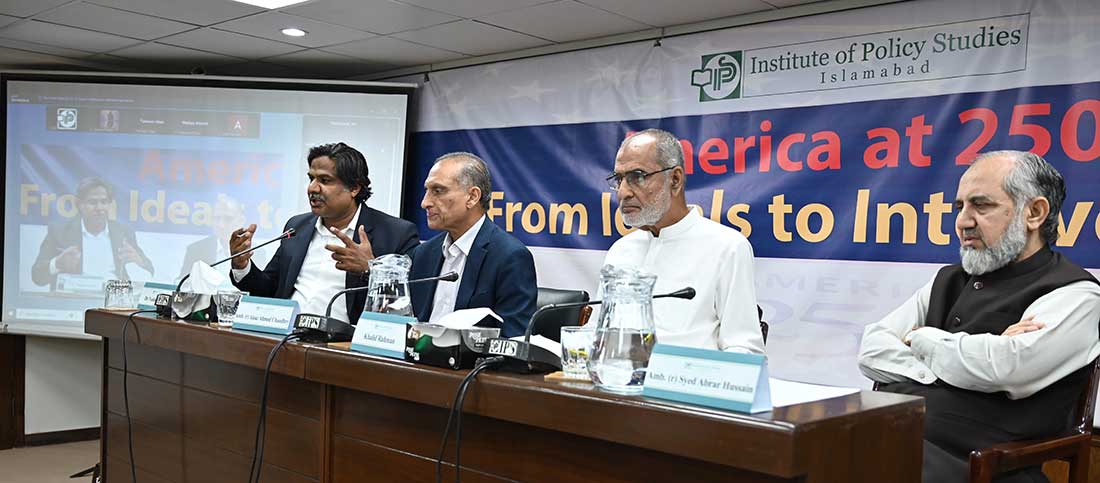
These views were expressed during a seminar titled “America at 250: From Ideals to Interventions,” organized by the Institute of Policy Studies (IPS), Islamabad, on July 15.
The seminar featured Ambassador (r) Aizaz Ahmad Chaudhry, former foreign secretary and ambassador to the United States, as keynote speaker. Other speakers included Ambassador (r) Syed Abrar Hussain, vice chairman, IPS; Dr. Nadeem Mirza, associate professor at Quaid-i-Azam University; and Khalid Rahman, chairman, IPS. The event brought together policy practitioners, members of the diplomatic community, academics, researchers, and students.
Speakers observed that the United States’ evolution from a republic founded on the ideals of liberty, self-determination, and democracy into a global power has continually tested the balance between moral principles and geopolitical interests. They noted that the country’s expanding international role has generated longstanding debates over whether great powers can preserve their founding values while exercising global influence, particularly in an increasingly multipolar world.
The discussion highlighted that the United States’ rise over the past 250 years has been underpinned by strong constitutional foundations, democratic institutions, the protection of individual liberties, and a sustained commitment to innovation. The enduring relevance of the Declaration of Independence and the US Constitution was cited as instrumental in fostering constitutional governance, checks and balances, economic freedom, civil liberties, scientific advancement, entrepreneurship, and institutional resilience.
At the same time, participants noted that America’s achievements have been accompanied by significant internal and external challenges, including the historical legacy of slavery and racial discrimination, widening economic inequality, political polarization, mounting public debt, and continuing debates over immigration. Speakers emphasized that preserving democratic ideals requires sustained efforts to address these structural and societal challenges.
The seminar also examined the intellectual foundations of American foreign policy. Discussants identified moralism, isolationism, and pragmatism as its three enduring pillars, observing that while the United States has consistently promoted universal values such as democracy, human rights, freedom, and self-determination, its foreign policy has generally prioritized national interests whenever these objectives have come into conflict.
Participants further observed that the nineteenth-century concept of “Manifest Destiny” gradually evolved into a broader international mission to advance American political values and institutions worldwide. They noted that recent American administrations, particularly under President Donald Trump, have represented a variation within this long-standing strategic tradition by questioning prolonged military interventions while continuing to place strong emphasis on national interests.
In his concluding remarks, Khalid Rahman emphasized that the rapidly changing international environment makes it increasingly difficult to analyze global affairs through static frameworks. He observed that a comprehensive understanding of America’s past 250 years also requires examining China’s evolving role and the broader transformation of the international system. He further noted that debates over intervention, power, and global leadership have long existed within American society, cautioning that when national or commercial interests consistently override ethical considerations, pragmatism risks becoming a justification for abandoning the very values it claims to protect.
The seminar concluded with an interactive question-and-answer session.