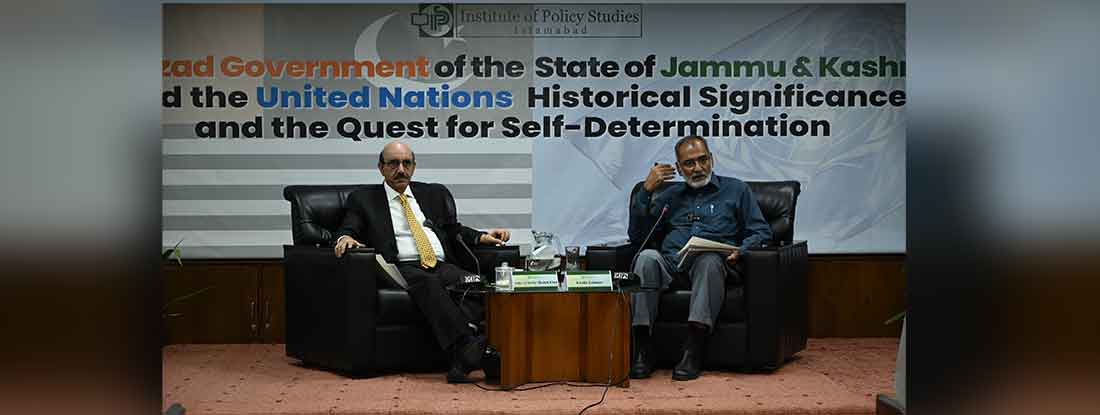
IPS Seminar Examines Historical and Diplomatic Dimensions of Kashmir Dispute and Quest for Self-Determination
The historical foundations of the Jammu and Kashmir dispute, the relevance of United Nations resolutions, and the role of the Azad Government of the State of Jammu and Kashmir in advancing the right to self-determination remain central to understanding the issue’s international dimensions. Despite decades of diplomatic engagement and changing geopolitical circumstances, the dispute continues to raise questions concerning international commitments, political representation, and the aspirations of the Kashmiri people. Sustained international advocacy, historical awareness, and effective political engagement remain important to keeping the issue on the global agenda.
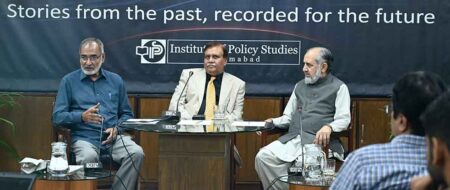
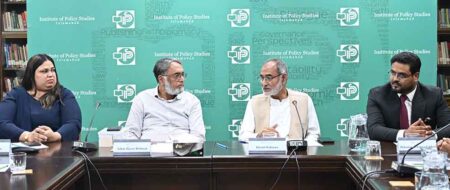
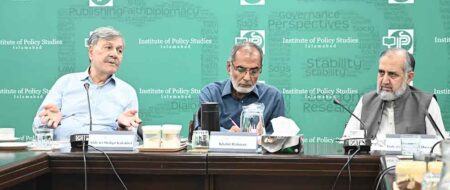
These views emerged during a seminar titled “The Azad Government of the State of Jammu and Kashmir and the United Nations: Historical Significance and the Quest for Self-Determination,” held on October 29, 2026, at the Institute of Policy Studies (IPS), Islamabad. The seminar featured Ambassador (r) Masood Khan, former President of Azad Jammu and Kashmir, as the keynote speaker. Dr. Umair Pervez, Assistant Professor, National Defense University (NDU), delivered the welcome remarks and moderated the session, while Khalid Rahman, Chairman, IPS, presented the concluding remarks.
Ambassador (r) Masood Khan traced the historical roots of the Kashmir movement to the nineteenth century, highlighting the events of 1832, the 1931 uprising, and the formation of the All Jammu and Kashmir Muslim Conference. He emphasized the importance of understanding the historical context of the struggle and recognizing the sacrifices made by generations of Kashmiris. He also discussed the political developments preceding and following 1947, underscoring their significance in understanding the evolution of the dispute.
Discussing the role of the United Nations, he maintained that despite limitations in implementing its resolutions, the organization remained an important legal and diplomatic platform for the Kashmir cause. He stressed that keeping the Kashmir dispute on the agenda of the UN Security Council was essential to preserving its international status. Referring to the India Independence Act of 1947 and relevant UN resolutions, he highlighted the historical and legal foundations associated with the right to self-determination.
Participants also examined the possibilities of strengthening international advocacy beyond conventional diplomatic channels. Ambassador (r) Masood Khan called for transforming the Kashmir cause into a broader international civil rights movement through coordinated engagement with global institutions, media, political representatives, and civil society. He emphasized the importance of unity among Kashmiris and building international partnerships to sustain attention on the issue.
The discussion further highlighted the responsibilities of the Azad Jammu and Kashmir government in advancing the Kashmir cause. Describing it as a base camp for the broader struggle, he stressed that its role should extend beyond local administration to international advocacy. Effective governance, public trust, and addressing citizens’ concerns were identified as equally important to strengthening its institutional role.
The seminar also featured an interactive question-and-answer session, during which students, researchers, and participants raised questions regarding the effectiveness of the United Nations, the implementation of its resolutions, the historical circumstances surrounding the dispute, and the political and diplomatic responsibilities of the Azad Jammu and Kashmir government.
In his concluding remarks, Khalid Rahman emphasized the importance of examining historical developments within their broader context rather than forming opinions based on isolated information. He highlighted the growing significance of information and narrative management in contemporary conflicts, encouraging participants to critically evaluate the information shaping public understanding of international issues.