9/11 transformed global order and weakened international legal framework: Mushahid Hussain Sayed
The September 11, 2001, attacks marked a major shift in global politics, reshaping the international security environment and setting in motion a prolonged “War on Terror” whose consequences extended well beyond the attacks themselves. The wars that followed imposed substantial human and economic costs, weakened the international legal framework, destabilized Pakistan and the wider region, and contributed to the decline of the unipolar global order.
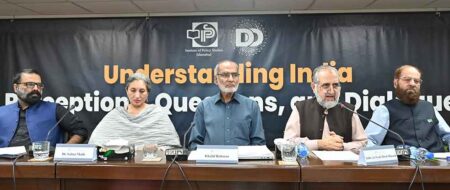
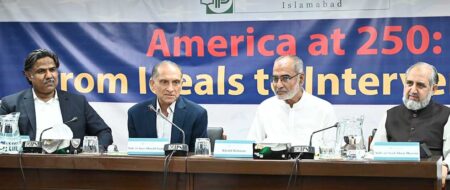
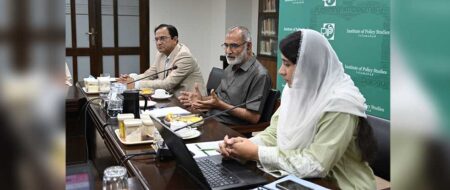
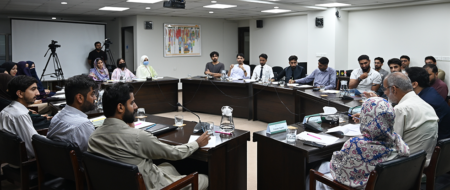
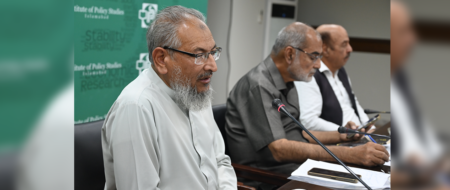
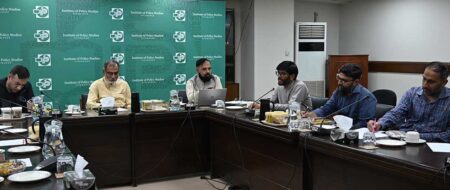
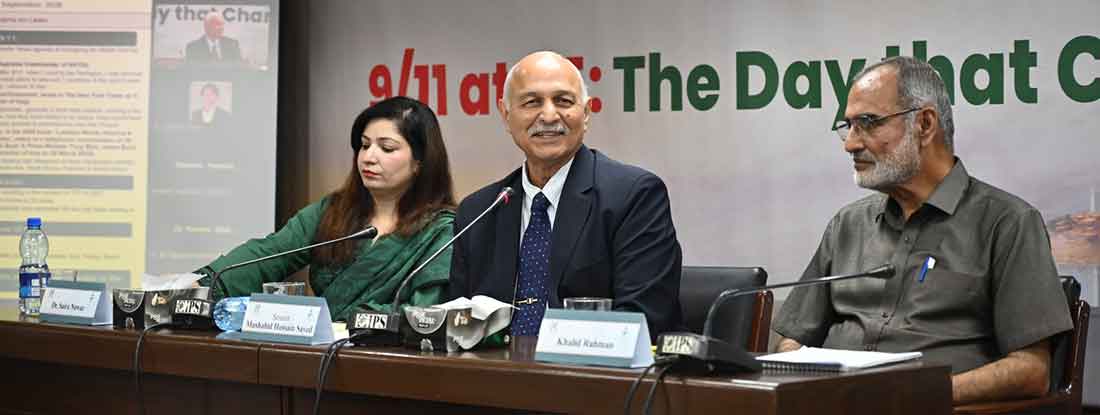
This was discussed during a guest talk titled “9/11 at 25: The Day that Changed the World,” organized by the Institute of Policy Studies (IPS), Islamabad, in collaboration with the Department of International Relations, Bahria University, Islamabad on Tuesday, September 15. The session featured Senator Mushahid Hussain Sayed, chairman, Pakistan-China Institute; Khalid Rahman, chairman, Institute of Policy Studies; and Dr. Saira Nawaz Abbasi, head, Department of International Relations, Bahria University.
Delivering the keynote address, Mushahid Hussain Sayed said the events of 9/11 altered the global balance of power and accelerated what he described as the decline of American unipolar dominance. Questioning the proportionality of the US response, he argued that the attacks were subsequently used to advance a broader geopolitical agenda. Referring to developments before 9/11, including the Project for the New American Century and its advocacy for reshaping the Middle East, he highlighted the role of regime change and military intervention in US strategic thinking.
Drawing on figures from Brown University’s Costs of War study, he highlighted the extensive human and financial costs associated with the wars following 9/11. He cited approximately $8 trillion in US expenditure, around one million direct deaths, millions of indirect deaths, and tens of millions of displaced people. He further noted that the US intervention in Afghanistan alone cost approximately $2 trillion over two decades. According to him, the inability to achieve the intended strategic objectives demonstrated the limitations of military intervention and contributed to the weakening of US global influence.
Discussing the regional consequences, Mushahid Hussain identified Afghanistan and Pakistan as among the countries most significantly affected by the post-9/11 environment. He argued that political arrangements established in Afghanistan did not sufficiently reflect the country’s historical and social realities, while Pakistan experienced serious destabilization, particularly in the former FATA region. He also pointed to the expansion of Indian influence in Afghanistan during the US occupation.
At the global level, he contrasted the US focus on military expenditure with China’s emphasis during the same period on economic connectivity and infrastructure, arguing that this difference contributed to China’s rise. He also referred to Russia’s recovery under President Vladimir Putin and the growing significance of Muslim-majority middle powers, including Pakistan, in an evolving international system.
Mushahid Hussain further highlighted the rise of Islamophobia and anti-Muslim prejudice as enduring consequences of the post-9/11 period. He noted the growth of right-wing political movements in parts of the West and linked contemporary tensions to longer historical narratives concerning Islam and the West. He stressed the importance of understanding competing historical and geopolitical perspectives while distinguishing facts from propaganda.
In his remarks, Khalid Rahman observed that declaring a “War on Terror” marked a departure from treating terrorism primarily as a criminal matter requiring investigation and prosecution. He identified the erosion of the international legal order as one of the most serious consequences of the post-9/11 response and underscored the continuing relevance of the United Nations and international law.
Dr. Saira Nawaz Abbasi stressed the importance of studying 9/11 to understand how systemic change is shaped. She explained that states can use speech acts to securitize particular issues in pursuit of domestic and international interests, citing President Bush’s framing of 9/11 as an American security issue. She consequently noted that security is not an objective phenomenon but can be understood as a subjective matter for state actors.
The session provided an opportunity to examine the long-term geopolitical, legal, economic, and societal consequences of 9/11 and the subsequent “War on Terror,” while reflecting on the transformation of the international order over the past 25 years.