BRSP Delegation Visits IPS to Discuss Interfaith Harmony, Youth Engagement, and Indigenous Knowledge Initiatives
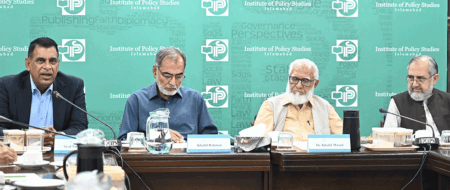
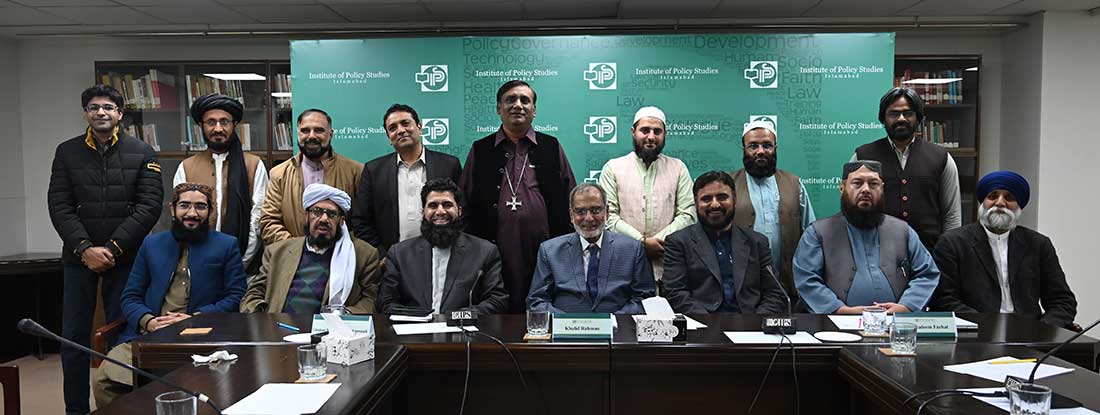
A delegation from the Balochistan Rural Support Program (BRSP) visited the Institute of Policy Studies (IPS), Islamabad, on December 19, 2025, for an interactive academic exchange focusing on interfaith harmony, youth engagement, and the role of indigenous knowledge in fostering inclusive and cohesive social discourse.
The session commenced with introductions of the delegation members, followed by a comprehensive overview of BRSP’s initiatives presented by Ghulam Muhammad Muhammadi, Manager, BRSP. He outlined BRSP’s educational and social interventions undertaken in collaboration with madaris, with particular emphasis on programs designed to promote interfaith understanding and social cohesion. These initiatives currently engage 150 madaris across 20 villages, facilitating students’ participation in co-curricular activities and organizing structured exposure visits to various regions of the country. Such engagements include visits to religious and civic institutions, notably the Lahore Mandir and the National Assembly of Pakistan, aimed at broadening perspectives and strengthening mutual respect.
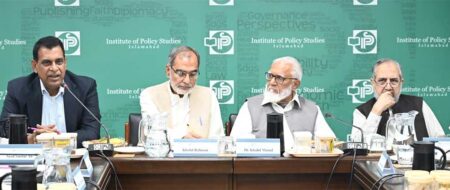
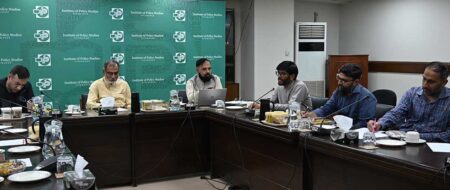
IPS team subsequently introduced the Institute’s mandate and research agenda, with particular focus on the Faith and Society program. This was followed by an interactive question-and-answer session with Khalid Rahman, chairman, IPS, during which participants engaged in substantive discussions on issues relating to faith, society, youth, and contemporary national challenges.
During the dialogue, members of the delegation sought clarification regarding “Khurshid Answers,” IPS’s artificial intelligence–based knowledge platform, built on the research comtributions of Late Professor Khurshid Ahmad, particularly concerning its scope and potential expansion. In response, Khalid Rahman and members of the IPS team elaborated on the conceptual vision of the platform and demonstrated its functionality through a live response addressing Professor Khurshid Ahmad’s views on interfaith harmony.
Khalid Rahman also initiated a discussion on the recent Sydney beach incident, prompting participants to share their perspectives. Several attendees condemned the incident and provided contextual analyses, situating it within broader social and interfaith dynamics.
In his remarks, Khalid Rahman contextualized the Sydney incident within wider challenges confronting interfaith harmony, the growing discourse on atheism, and contemporary social movements such as #MeToo, particularly highlighting concerns related to the misuse and distortion of information. He emphasized the need for balanced analysis, ethical responsibility, and informed public discourse in addressing such complex societal issues.
The session further included a discussion on IPS’s Youth Empowerment Initiative, highlighting institutional efforts to engage young people through research, dialogue, and capacity-building frameworks. Additionally, participants raised questions regarding socio-economic conditions in Balochistan, including challenges faced by local communities and madaris. While some concerns were expressed in emotive terms, others sought analytical insights into prospects for Pakistan’s future.
Responding to these queries, Khalid Rahman offered a comprehensive and reflective assessment of Pakistan’s challenges and opportunities, addressing both national and regional dimensions, with particular reference to Balochistan. His observations were widely noted by participants for their depth and analytical clarity.
The session concluded with closing remarks and a formal vote of thanks by Ghulam Muhammad Muhammadi, who expressed appreciation to IPS for facilitating a meaningful and intellectually enriching exchange of perspectives.