Modernization without indigenous identity leaves nations at crossroads: IPS discussion
Sustainable modernization demands the ability to reconcile progress with indigenous identity, historical experience, and societal realities. Across the last three centuries, many non-European societies sought to bridge the gap with the West in power and prosperity, yet only a limited number succeeded in building enduring models of development. For countries like Pakistan, these historical experiences offer important lessons on how modernization can be pursued without losing cultural confidence or national direction.
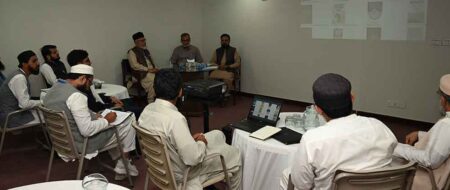
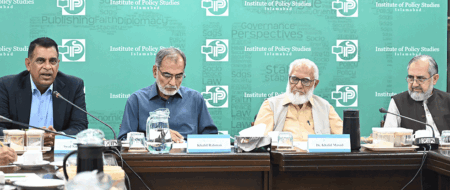
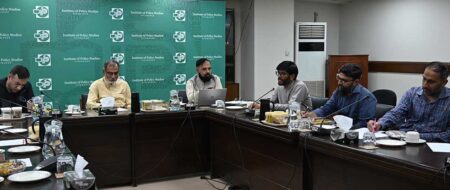
The reflections emerged during the second session of discussion series titled “The Rise and Fall of Civilizations: Contemporary Context” at the Institute of Policy Studies (IPS), held on April 15, 2026. This discussion was organized around the thesis work of Syed Sardar Ali (founder and chairman of Pakistan Crescent Foundation) regarding modernity, Islam, and Pakistan.
The participants in the discussion session included: Khalid Rahman, Chairman, Institute of Policy Studies; Amb. (R) Syed Abrar Hussain, Vice Chairman, Institute of Policy Studies; Dr. Khalid Masud, Member, Shariat Appellate Bench, Supreme Court of Pakistan; Engr. Arshad Dad, social worker and philanthropist; Sardar Khalid; Dr. Nasir Hafeez, SVI Institute; Nauman Akram; Advocate Imran Shafique; Dr. Waleed Rasool, Research Associate, Institute of Policy Studies; Dr. Nadeem Abbas, Al-Mustafa International University; Abdul Haseeb, CVRF; Advocate Muhammad Bin Sajid; Muhammad Asim, CEF; and Dr. Sohaib Zafar, CEF.
Reviewing the strategies by major civilizations in response to the Western dominance after Europe’s military and economic ascendancy, it was noted that the expansion of European maritime and military power compelled many nations to study Western methods of warfare, administration, and industrial development in order to preserve sovereignty and remain competitive.
Reviewing historical case studies, the speaker highlighted Russia’s long and unfinished quest for modernity, beginning with the reforms of Peter the Great and continuing through the Soviet industrial era and post-Cold War transition. Despite major advances, Russia’s search for stable modernization and parity with Western Europe was described as incomplete.
Japan was presented as a thriving example of non-Western modernization. Beginning with the Meiji Restoration in 1868, Japan adopted modern institutions, strengthened industry, and restructured governance. Within a century, it had emerged as a leading global economy, becoming the first non-European state to substantially catch up with the West.
China’s transformation was discussed as another significant model. Following nineteenth-century military defeats and failed reform efforts, the Communist revolution of 1949 established new institutions and laid the foundations of industrial growth. Economic reforms initiated in 1979 were described as having accelerated development dramatically, lifting millions out of poverty and offering developing nations an alternative pathway to modernization.
The discussion also assessed the mixed experiences of Egypt and Türkiye. Egypt’s early modernization under Muhammad Ali Pasha was termed pioneering in the Muslim world, yet subsequent decades were marked by political instability, external intervention, and unresolved tensions between secular nationalism and religious identity. Türkiye, after the fall of the Ottoman Empire, pursued strong republican reforms under Mustafa Kemal Atatürk but continues to navigate competing pulls of secular modernity and Ottoman-Islamic heritage.
Discussing broader patterns, the speaker observed that many societies initially resisted Western influence through traditional zealotry before later adopting foreign military tools, administrative systems, legal codes, and educational models. In several cases, these gradual reforms created tensions between modernizers and traditionalists, sometimes culminating in revolutionary upheaval.
Referring to Pakistan, the session noted that many non-core states of older civilizations have generally pursued reform rather than revolutionary transformation. This, it was argued, places greater importance on carefully designed institutional development, indigenous intellectual renewal, and long-term strategic vision.
In concluding remarks, participants were told that the central challenge for Pakistan and the wider Muslim world is to draw lessons from successful modernization experiences while preserving their own civilizational values, as sustainable modernization requires not merely copying foreign institutions or technologies but balancing progress with indigenous identity, historical experience, and societal realities. The speaker said future discussions would focus on whether universal patterns of progress exist and how such lessons may inform Pakistan’s path forward.