Living Script with Dr Tariq Mustafa(TI)
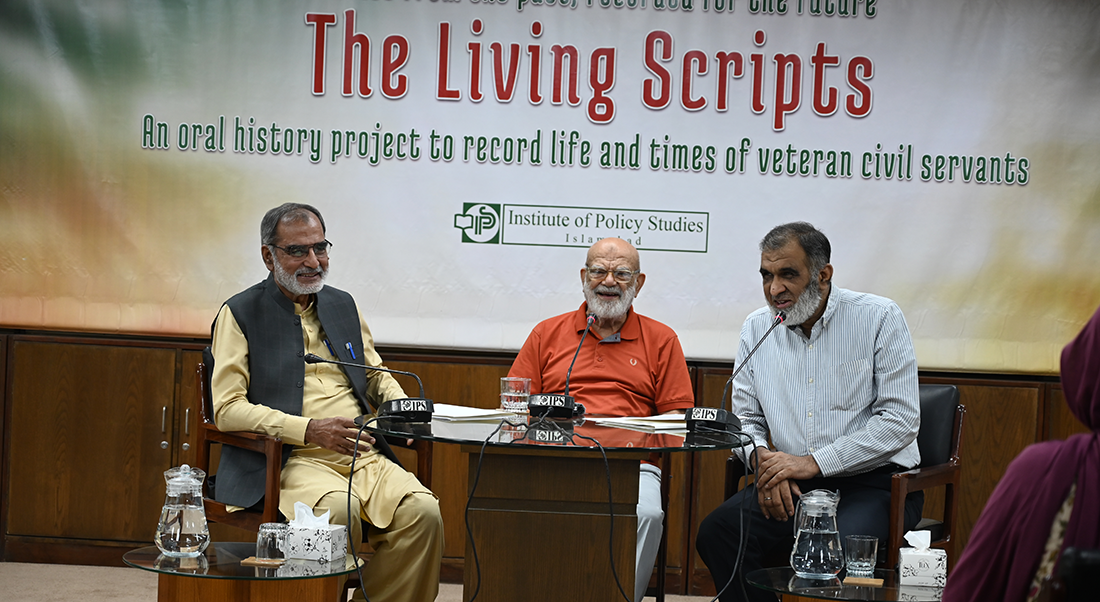
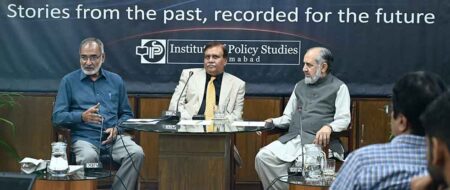
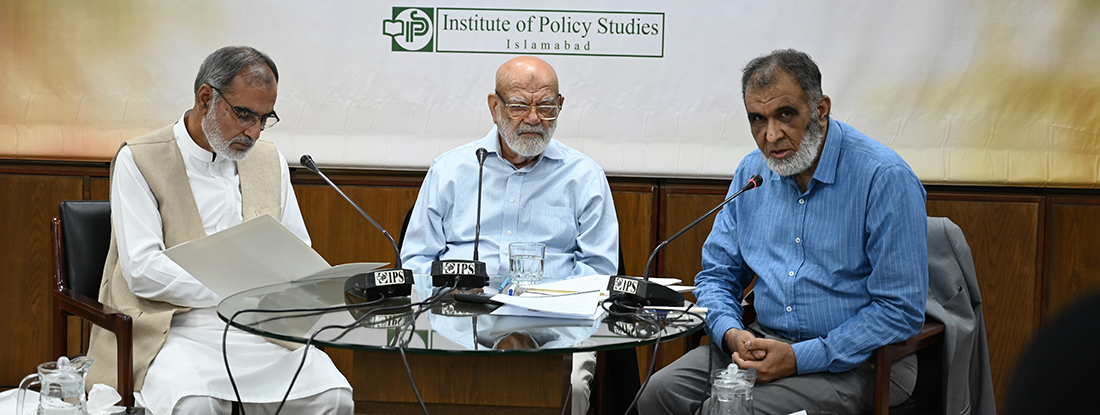
The 36th session of IPS’ oral history project ‘The Living Scripts’ was held with Dr Tariq Mustafa, former federal secretary, Ministry of Defense Production, and Pioneer of Pakistan Space Program, in the Institute of Policy Studies (IPS), Islamabad, on July 10, 2025, and July 17, 2025.
Dr Tariq Mustafa was born in 1934 in Lyallpur (now Faisalabad). His family migrated from Jalandhar during the pre-Partition period and settled in Lyallpur. He studied on scholarship at Central Model School and later at Government College Lahore, excelling academically and showing an early spark of discipline and curiosity. Amidst studies, he enjoyed playing traditional games like tipcat.
Dr Mustafa began his academic journey with a first-class honors degree in Mechanical Engineering from the University of London, followed by an apprenticeship at the Royal Arsenal in Woolwich. He pursued advanced studies in nuclear engineering at the UK Atomic Energy Authority and later at the Oak Ridge National Laboratory in the United States under a USAID Fellowship.
In 1961, Nobel Laureate Prof. Abdus Salam selected Dr Mustafa to lead Pakistan’s entry into space research. He recalled that, st a critical juncture in the Cold War, Yuri Gagarin’s entry into space had spurred the US to launch the Apollo Program, which required meteorological data from the Indian Ocean, an area previously unmapped in this context at that time. The US extended an offer to countries in the region, including Pakistan, proposing technical support in rocketry in exchange for data collaboration. Dr. Mustafa, alongside Prof. Salam, agreed to the offer after receiving approval from President Ayub Khan. This led to Pakistan’s first collaboration with NASA, and the establishment of the Sonmiani rocket range, culminating in the historic launch of Rehbar-I in June 1962.
Over the years, Dr Mustafa held top leadership positions in Pakistan’s federal ministries. He served as Federal Secretary in five key ministries, including Defense Production, Science & Technology, and Petroleum & Natural Resources. His 14-year tenure in defense production was pivotal in modernizing Pakistan’s military capabilities, overseeing the development of aircraft, tanks, submarines, and missile boats. He also played a critical role in the privatization of major public-sector enterprises, working closely with the World Bank on high-impact reforms such as the privatization of the Kot Addu Power Plant.
Internationally, Dr Mustafa served as Minister (Technical) at the Pakistani Embassy in Washington D.C., managed US-Pakistan technical relations, and advised the World Bank on technology transfer and privatization. He has represented Pakistan on the global stage under six Prime Ministers and Presidents, engaging with world leaders like Ronald Reagan, Margaret Thatcher, Shah of Iran, Ayatollah Khomeini, Ali Akbar Rafsanjani, Hafez al-Assad, Muammar Gaddafi, and Deng Xiaoping
Beyond engineering and policy, Dr. Mustafa is a passionate advocate for disability inclusion. As President of the Pakistan National Paralympic Committee since 1998, he has led the country to win over 85 medals in regional and international competitions and continues to champion the rights of athletes with disabilities.
With a career marked by innovation, service, and global engagement, Dr Tariq Mustafa’s legacy is one of enduring impact, bridging disciplines, generations, and continents.