Pakistan as a Eurasian Gateway: The Game Plan
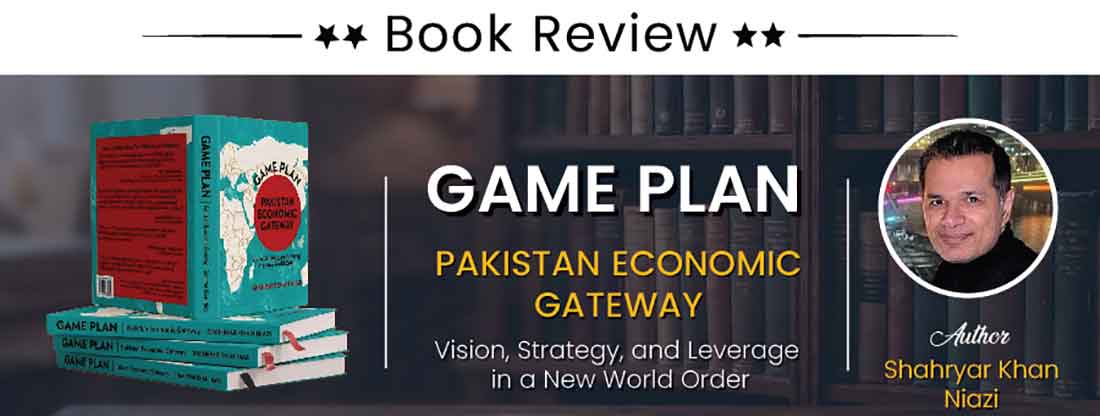
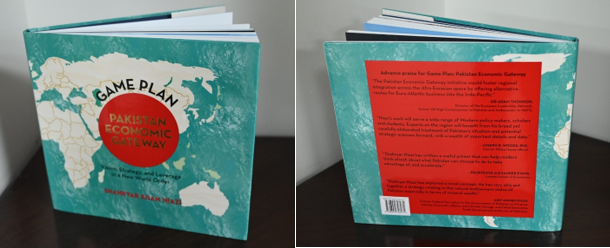
Shahryar Khan Niazi’s Game Plan: Pakistan Economic Gateway is an ambitious attempt to reframe Pakistan not as a peripheral actor buffeted by great-power competition, but as the geographic and logistical support of a reordering Eurasian and Indo-Pacific system. Structured across thirteen chapters and five appendices, the book moves outward from global maritime chokepoints to the specific architecture of what the author calls the “Pakistan Economic Gateway” (PEG), before returning to a concluding strategic prescription for Islamabad in an emerging multipolar order.
The book starts with chapters on maritime trade, the Indian Ocean, and the “Euro-Atlantic” legacy order, before pivoting to three chapters that anchor its geopolitical framing: Russia (Dream of a Supercontinent), China (The Re-emergence of the Pax Sinica), and India (New Power on the Block). The Russia chapter is explicitly Mackinderian in its framing – it opens with the Heartland thesis and reads Moscow’s Eurasian Economic Union, its BRICS diplomacy, and its post-2022 pivot toward Asia as a coherent project of continental consolidation rather than as a purely reactive posture. This chapter, together with the China chapter’s treatment of the Belt and Road Initiative, sets up the book’s central move: Pakistan is positioned not as a junior partner to any one power, but as connective tissue between Russian, Chinese, South Asian, Gulf, and European trade systems.
Chapter Seven, “The Grand Strategy: Pakistan Economic Gateway,” is by far the longest section and functions as the book’s core. It elaborates a dense lattice of proposed and existing corridors – the Pakistan-Iran-Turkey-Europe corridor (PITE), the Pakistan-Gulf Cooperation Council corridor (PGCC), the China-Pakistan Economic Corridor (CPEC), and a Pakistan-Central Asia link routed through the overland border crossings of Torkham, Chaman, and Taftan. It also introduces the “Asian Battery Corridor” concept, tying Chagai’s copper-gold reserves and broader Central and South Asian critical-mineral deposits into global battery and EV supply chains.
The subsequent chapters on TIR accession, Chagai, Gabd, and Sonmiani read almost as case studies of this central argument, each showing a specific node – a mineral deposit, a border crossing, a green hydrogen port – folded into the same connective vision. The book closes with “Pakistan: Navigating the Second Cold War,” which draws on Mahan, Corbett, and Castex to argue for an integrated Eurasian-and-maritime strategy and a “Blue Ocean” naval doctrine, framed by Palmerston’s dictum on the absence of eternal allies.
For work on Pakistan-Central Asia-Russia connectivity specifically, the book’s most useful material is empirical rather than theoretical. Appendix II, the “Pakistan-Iran-Eurasia Corridor Case Study,” is a good example: it quantifies a hypothetical Finland-Australia trade route via Gwadar against the conventional maritime route, suggesting a reduction from 46 days and roughly 19,600 km by sea to 26 days and about 14,600 km via the Pakistan-Iran-Eurasia land bridge. This is precisely the kind of comparative-advantage illustration that gives connectivity scholarship something concrete to work with – transit time, distance, and border-crossing friction treated as variables rather than abstractions.
The TIR chapter is similarly valuable as a primary-source snapshot of Pakistan’s 2015 accession to the Transports Internationaux Routiers convention and its practical implications for customs-free transit, which bears directly on questions of Pakistan-Central Asia trade facilitation.
The book is best approached with an awareness of its genre: it reads less as a conventional work of academic international relations and more as a strategic-vision and policy-oriented work, and its strengths and limitations both follow from that. The theoretical references to Mackinder, Mahan, and Corbett function primarily as framing references, with some of the associated arguments receiving less detailed analytical development. The corridor proliferation – PEG, PITE, PGCC, PIL, PISE, PIBC, and further acronyms layered on top of pre-existing ones like CPEC and TAPI – can at times appear more classificatory than analytical, particularly where multiple concepts and acronyms are introduced. The reader is given a rich cartographic vocabulary, but there is comparatively less discussion of political-economy considerations such as financing, security in Balochistan, Afghan transit instability, and Iran sanctions exposure that would be important in assessing the practical feasibility of these corridors. The methodology draws mainly on open-source maps, reporting, and think-tank commentary, which suits its intended audience well and gives the book a useful, accessible sweep, even if it leaves room for further empirical grounding in more specialized scholarly work.
Read as a primary artifact of contemporary Pakistani strategic discourse, the book has real value. It offers a clear picture of how the “gateway” and “pivot” framing of Pakistan’s geography is currently being articulated, and its treatment of Russia’s Eurasian ambitions, China’s BRI, and India’s Indian Ocean doctrine within a single connective frame echoes, in a more accessible register, the same regional logic that scholarship on Pakistan-Central Asia-Russia connectivity engages with in greater depth. It sits well as a discourse-analysis source – evidence of how the PEG concept is being articulated domestically and internationally – and its case-study appendices offer citable illustrative data points on land-bridge time and distance economics, worth cross-checking against other sources where precision is needed.
In sum, the book is best understood as a vision document: strong in cartographic and conceptual ambition, and a useful reference point for tracking Pakistan’s official and quasi-official framing of its Eurasian connectivity role, pairing well with more theoretically grounded and empirically verified scholarship for deeper academic argument.
(Dr. Faisal Javaid is Head of Department of International Relations and Mass Communication/Deputy Director ORIC, Federal Urdu University of Arts, Sciences & Technology, Islamabad)