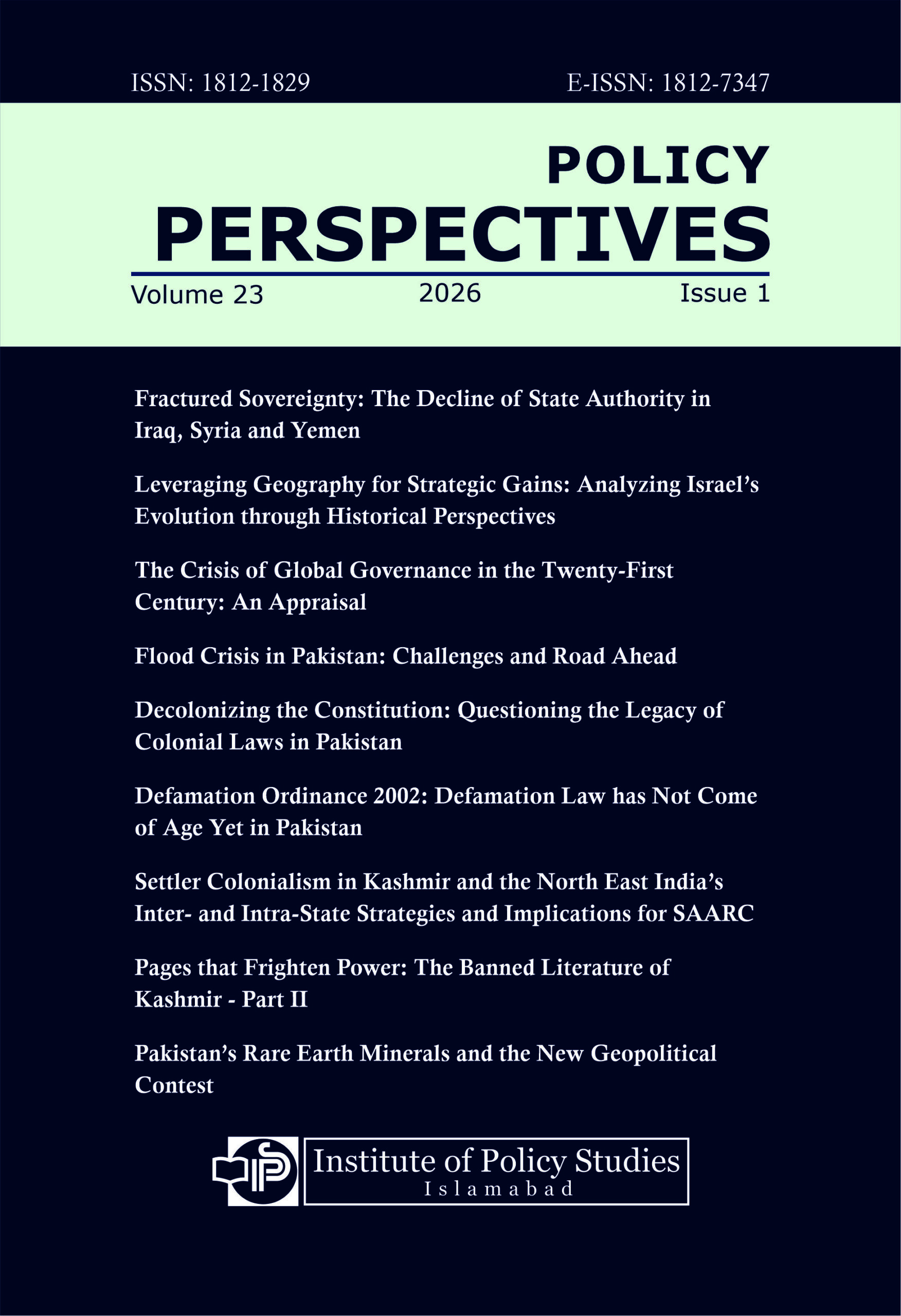
Policy Perspectives (Volume 23, Issue 1, 2026)
 |
Editor-in-Chief: Khalid Rahman Editor: Prof Dr Fakhr-ul-Islam Retail Price (Pak): PKR600 Annual Subscription: PKR1000 Export Price: $60 (per copy) Annual International Subscription: $120 Download Contents |
About the Issue
The latest issue of Policy Perspectives presents research, analyses, and discussion on various topics concerning national and international matters from policy experts, academics, and practitioners.
The pace of global change has accelerated significantly, with developments unfolding at an unprecedented speed. This is particularly evident in the field of International Relations, where rapidly evolving dynamics pose challenges for timely and comprehensive analysis. In this issue of Policy Perspectives, the first three articles offer valuable background and context to the ongoing crisis in the Middle East.
Since the Arab Spring, the Middle East’s traditional state system has weakened, giving rise to fragmented power structures. Dr Kardo Rached and Dr Hogr Tarkhani et al. in their paper “Fractured Sovereignty: The Decline of State Authority in Iraq, Syria, and Yemen” explore the erosion of nation-states in Iraq, Syria, and Yemen, and the growing influence of non-state actors, including militias and foreign-backed groups. They link this shift to historical divisions, authoritarianism, foreign intervention, and oil dependency, while also examining Iran’s role in shaping regional dynamics.
Authors: Dr Kardo Rached, Assistant Professor, University of Human Development, Sulaymaniyah, Iraq; Sbey Research Center, Sulaymaniyah, Iraq; Dr Hogr Tarkhani, Assistant Professor, Department of Political Science, Louisiana State University, Baton Rouge, United States; Halo Salh, Independent Researcher.
https://doi.org/10.13169/polipers.23.1.ra1
Emerging from a complex mix of global intervention, power politics, regional rivalries, and geo-economic interests, the establishment of Israel in Palestine set the stage for a prolonged and deeply rooted conflict in the Middle East. The paper on “Leveraging Geography for Strategic Gains: Analyzing Israel’s Evolution through Historical Perspective” examines Western strategic support for the establishment of Israel in a geographically critical region and its implications for the marginalization of Palestinians and neighboring Arab states. It analyzes how Israel’s geography has shaped its formation, security posture, and regional influence, alongside persistent allegations of human rights violations and war crimes.
Author: Dr Muhammad Farooq, Geopolitical Expert.
https://doi.org/10.13169/polipers.23.1.ra2
Aneela Shahzad in her paper“The Global Governance Crisis in the Twenty-First Century: An Appraisal” outlines the evolution of global governance, assesses its shortcomings, and explores alternative prospects for its role in an emerging multipolar order. Although the United States (US) enjoyed the post-1945 predominance that shaped the UN’s agendas, enforcement patterns, and veto politics, since the 9/11 attacks, Global War on Terrorism (GWOT), and the aftermath of the Arab Spring, among others, Washington’s capacity and apparent willingness to underwrite a global order have visibly declined. She evaluates how these dynamics have diminished the effectiveness of the United Nations and discusses prospects for reforming global governance.
Author: Aneela Shahzad, Geopolitical Analyst; Author of the books: Understanding Politics; Geopolitics— From the Other Side; and Geopolitics – Frameworks and Dynamics in a Multipolar World.
https://doi.org/10.13169/polipers.23.1.ra3
Developing countries are disproportionately being impacted by the changing climate. This is primarily due to their reliance on climate-sensitive sectors and limited capacity to adapt. Likewise, Pakistan’s growing exposure to climate extremes has transformed floods from periodic natural events into a chronic national crisis. This paper “Flood Crisis in Pakistan: Challenges and Road Ahead” examines how environmental change has intensified both the frequency and severity of flooding, while governance gaps—particularly in urban planning and water management—have compounded impacts across food security, livelihoods, and the economy.
Author: Faryal Qazi, Researcher, Institute of Policy Studies (IPS), Islamabad, Pakistan.
https://doi.org/10.13169/polipers.23.1.ra4
Shahl Khoso in his article “Decolonizing the Constitution: Questioning the Legacy of Colonial Laws in Pakistan” argues that the presence and glorification of archaic British colonial laws in Pakistan’s constitution(s), based on the Government of India Act of 1935 inter alia, may explain its democratic boom and authoritarian bust. He underscores the critical role of these laws in shaping the nation’s legal landscape, among other ramifications including ethnic relations, institutional power, and centre-province relations. He also argues that the use of laws from the colonial era, devised to regulate the colonised and extract mass resources from the colony, perpetuates legal loopholes that various stakeholders exploit to their advantage.
Author: Shahal Khoso, PhD Scholar, Department of Political and Social Sciences, Universitat Pompeu Fabra, Barcelona, Spain.
https://doi.org/10.13169/polipers.23.1.ra5
The next paper “Defamation Ordinance 2002: Defamation Law has Not Come of Age Yet in Pakistan” examines defamation law in Pakistan, focusing on how it seeks to balance freedom of expression with the protection of individual reputation. While Pakistan has developed a legal framework through federal and provincial laws, including the Defamation Ordinance 2002 and newer digital regulations, the study critically analyzes judicial interpretations of the 2002 Ordinance. It finds that despite extensive case law, key issues—such as actionable defamation, jurisdiction, and damages—remain inconsistently addressed, leaving Pakistan’s defamation jurisprudence underdeveloped and lacking a coherent, balanced framework.
Author: Farqaleet Khokhar, Corporate Lawyer, RIAA Barker Gillette, Islamabad, Pakistan.
https://doi.org/10.13169/polipers.23.1.ra6
Dr Waleed Rasool in his paper “Settler Colonialism in Kashmir and the North East: India’s Inter- and Intra-State Strategies and Implications for SAARC” applies post-colonial theory to the Kashmir issue, comparing India’s approach in Jammu and Kashmir with its policies in the North-Eastern states and its regional strategy toward SAARC countries. He identifies a pattern of territorial control marked by initial political accommodation followed by legal restructuring and settler-colonial practices. He argues that India now functions as a colonizing power, highlights gaps in potential UN responses, and draws strategic lessons for smaller regional states.
Author: Dr Waleed Rasool, Executive Director, Institute of Multi-Track Dialogue, Development and Diplomatic Studies (IDDS), Islamabad, Pakistan.
https://doi.org/10.13169/polipers.23.1.ra7
Rare earth minerals are critical to global technology and strategic competition, with China dominating supply chains. This has prompted efforts by the United States (US) and others to diversify sources, highlighting Pakistan’s emerging mineral potential and its prospective role in future supply chains. Rare earth mining is capital-intensive, technologically demanding, and environmentally sensitive. In addition, difficult terrain, infrastructure gaps, security concerns in mineral-rich regions, and fragmented regulatory frameworks also pose significant challenges. Moreover, global competition over critical minerals introduces a geopolitical dimension that necessitates careful management to prevent strategic entanglements. To explore Pakistan’s rare earth potential from geological, economic, and strategic perspectives, Policy Perspectives convened a written symposium on “Pakistan and the New Global Race for Rare Earth Minerals” in which Jameela Achakzai, took insights from experts including Irshad Ali Khokhar, Mushahid Hussain Sayed, Abdul Shakoor Mastoi, Khalid Mahmood, and Nawaz Ahmad Virk.
Interviewer: Jameela Achakzai,Journalist; Associate, Institute of Policy Studies (IPS), Islamabad, Pakistan.
Interviewees: Irshad Ali Khokhar, former director general Minerals Pakistan, and former chairman of the Pakistan Mineral Development Corporation (PMDC), Islamabad, Pakistan; Mushahid Hussain Sayed, veteran parliamentarian and foreign policy analyst; Dr Abdul Shakoor Mastoi, associate professor at the Centre for Pure & Applied Geology, University of Sindh, Jamshoro; Ambassador Khalid Mahmood, chairman of the Board of Governors of the Institute of Strategic Studies Islamabad (ISSI), Islamabad, and Dr Nawaz Ahmad Virk, director general (minerals) at the Ministry of Energy, Government of Pakistan.
https://doi.org/10.13169/polipers.23.1.symp
On August 5, 2025, six years after revoking Jammu and Kashmir’s special status, India escalated its crackdown by banning 25 books under Section 98 of the BNSS, 2023, labeling them ‘seditious’ or ‘radicalizing’ and prohibiting their possession or circulation. The essay ‘Pages that Frighten Power: The Banned Literature of Kashmir: Part II’—is the second in the series reviewing the 25 banned books on Kashmir—examines remaining 12 of these works to accentuatate voices that raise questions of legality and the long-standing challenges faced by the Kashmiris. Part I featured 13 books, which had been banned by India, published in Volume 22, Issue 2 (2025) of Policy Perspectives.
Reviewers: Dr Adam Saud, Senior Professor and the Dean of the Faculty of Humanities and Social Sciences at Bahria University in Islamabad, Pakistan; Altaf Hussain Wani, Chairman, Kashmir Institute of International Relations (KIIR), Islamabad, Pakistan; Abdul Rehman, Research Officer, Muzaffarabad, Azad Jamuu and Kashmir (AJK), Pakistan; Iftikhar Gilani, Independent Journalist; Waleed Rasool, Executive Director, Institute of Multi-Track Dialogue, Development and Diplomatic Studies (IDDS), Islamabad, Pakistan; Adnan Sarwar, Head of Department, International Relations, National University of Modern Languages (NUML), Islamabad, Pakistan; Malik Waleed, Researcher, Institute of Policy Studies (IPS), Islamabad, Pakistan; Nasir Qadri, Human Rights Lawyer.
https://doi.org/10.13169/polipers.23.1.symp
The full text of the articles is available at ScienceOpen.