ISSN: 1812-1829 E-ISSN: 1812-7347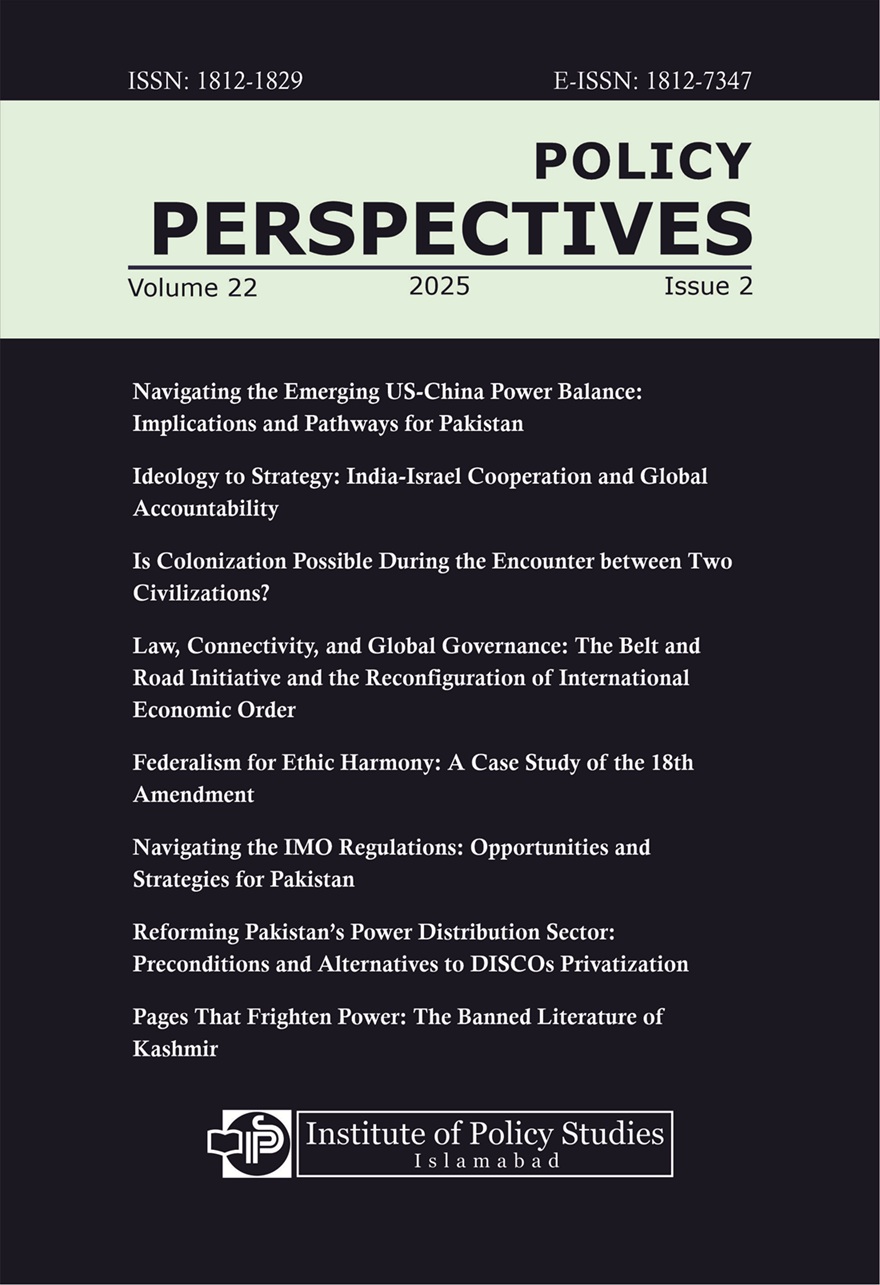 Policy Perspectives is a peer-reviewed, open access, biannual journal of Institute of Policy Studies (IPS), Islamabad, which also brings forth occasional special issues. The journal disseminates the research carried out by the Institute and its associates on diverse range of current and evolving topics. The digital edition of the Journal is co published and distributed by Pluto Journals, UK.
Policy Perspectives is a peer-reviewed, open access, biannual journal with occasional special issues, published by Institute of Policy Studies (IPS) –an Islamabad-based think tank dedicated to promoting policy-oriented research and human development. Established in 1979, the Institute defines Pakistan Affairs, International Relations and Faith and Society as its primary research areas, which are further divided into various sub-themes for focused studies. The Institute’s research spanning over four decades has so far produced over 1500 seminars, conferences and roundtables, around 400 publications, and about 2500 research reports. Policy Perspectives is the flagship journal of the Institute,disseminating the research carried out by IPS and its associates on diverse range of current and evolving topics. The journal reaches out to a large number of individual and institutional researchers, policy makers, key opinion leaders and other stakeholders within the country and across the globe, extending policy-oriented analysis, perspectives and recommendations on issues of national and global significance.
Policy Perspectives is distinctive in combining original research papers with reflective studies and analysis on varied themes and issues. Contributions to the journal appeal to a wide academic and professional readership, and reach an interdisciplinary and international audience. The Journal welcomes original, unpublished scholarly articles from research scholars, experts and policy practitioners. and accepts contributions in the thematic areas of international relations, Pakistan affairs, and faith and society in general, and the topics related to security, society, economy, strategy, governance and foreign policy in particular.
EDITORIAL BOARD
Editor-in-Chief: Khalid Rahman
Editor: Dr Fakhr-ul-Islam
Associate Editors: Syed Nadeem Farhat, Zahida Khalid
Editorial Assistant: Shafaq Sarfaraz
EDITORIAL ADVISORY BOARD
Dr Aisha Ahmad
Associate Professor, Department of Political Science, Centre for South Asian Studies, The Asian Institute; Co-Director of the Islam and Global Affairs Initiative, Munk School of Global Affairs and Public Policy, University of Toronto, Toronto, Canada.
Dr Akis Kalaitzidis
Professor, International Relations and Comparative Politics, School of Social Science and Languages, College of Arts, Humanities, and Social Sciences, University of Central Missouri, Warrensburg, USA.
Dr Ivan Safranchuk
Director; Senior Research Fellow, Centre of Central Asia and Afghanistan of the Institute for International Studies, Moscow State Institute of International Relations (MGIMO) University, Moscow, Russia.
Dr Muhammad Umer Chapra
Advisor, Islamic Research and Training Institute (IRTI), Islamic Development Bank (IDB), Jeddah, Saudi Arabia.
Dr Robert Jensen
Professor Emeritus, School of Journalism, Moody College of Communication, University of Texas, Austin, USA.
Prof. Roger van Zwanenberg,
Managing Director, Pluto Journals, London, UK.
Dr Shahram Akbarzadeh
Research Professor, Middle East & Central Asian Politics, Faculty of Arts and Education, Alfred Deakin Institute, Deakin University, Melbourne, Australia.
Dr Torkel Brekke
Professor, Cultural and Religious Diversity, Department of International Studies & Interpreting, Oslo Metropolitan University, Oslo, Norway.
Dr Wang Xu
Associate Professor, Executive Director, Department of South Asian Studies, School of Foreign Languages, Peking University, Beijing, China.
Dr Zahid Hussain Bukhari
Executive Director, Center for Islam and Public Policy (CIPP), Washington, DC, USA.
Policy Perspectives is indexed/abstracted in the following:
- International Political Science Abstracts (IPSA)
- Norwegian Register for Scientific Journals
- Directory of Open Access Journals (DOAJ)
- ProQuest
- EBSCO
- Factiva
- Ovid
- ResearchBib
- JSTOR
- Portico
- Crossref
- Google Scholar
- ResearchBib
- Duotrope
- Journament
- Asianet Pakistan
 |
 |
 |
 |
 |
 |
 |
 |
 |
 |
 |
 |
 |
 |
 |
|
Last updated on 22 March 2023
Call for Papers
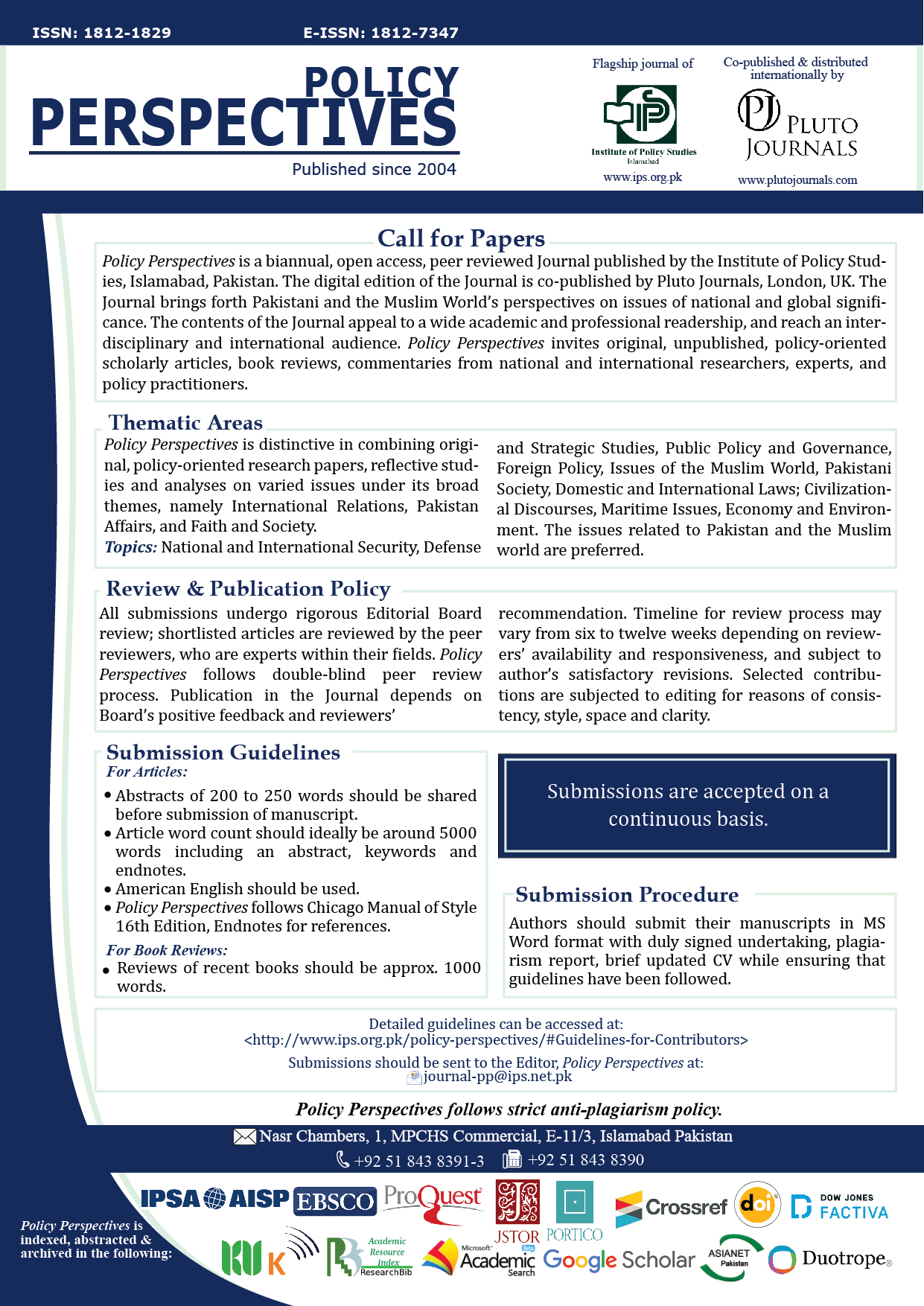
Policy Perspectives is a biannual, open access, peer reviewed Journal published by the Institute of Policy Studies, Islamabad, Pakistan. The digital edition of the Journal is co-published by Pluto Journals, London, UK. The Journal brings forth Pakistani and the Muslim World’s perspectives on issues of national and global significance. The contents of the Journal appeal to a wide academic and professional readership, and reach an interdisciplinary and international audience. Policy Perspectives invites original, unpublished, policy-oriented scholarly articles, book reviews, commentaries from national and international researchers, experts, and policy practitioners. Thematic Areas Policy Perspectives is distinctive in combining original, policy-oriented research papers, reflective studies and analyses on varied issues under its broad themes, namely International Relations, Pakistan Affairs, and Faith and Society. Topics: National and International Security, Defense and Strategic Studies, Public Policy and Governance, Foreign Policy, Issues of the Muslim World, Pakistani Society, Domestic and International Laws; Civilizational Discourses, Maritime Issues, Economy and Environment. The issues related to Pakistan and the Muslim world are preferred. Peer Review & Publication Policy All submissions undergo rigorous Editorial Board review; shortlisted articles are reviewed by the peer reviewers, who are experts within their fields. Policy Perspectives follows double-blind peer review process. Publication in the Journal depends on Board’s positive feedback and reviewers’ recommendation. Timeline for review process may vary from six to twelve weeks depending on reviewers’ availability and responsiveness, and subject to author’s satisfactory revisions. Selected contributions are subjected to editing for reasons of consistency, style, space and clarity. Submissions are accepted on a continuous basis. Submission Guidelines For Articles:
- Abstracts of 200 to 250 words should be shared before submission of manuscript.
- Manuscripts should be in MS Word format.
- Article word count should ideally be around 5000 words including an abstract, key words and endnotes.
- American English should be used.
- Policy Perspectives follows Chicago Manual of Style 16th Edition, Endnotes for references. (For examples, please see detailed guidelines.)
Detailed guidelines can be accessed at: http://www.ips.org.pk/policy-perspectives/#Guidelines-for-Contributors For Book Reviews:
- Book Reviews of recent books should be approx. 1000 words.
Submission Procedure: Authors should submit their manuscripts with duly signed undertaking, plagiarism report, brief updated CV while ensuring that guidelines have been followed at the following address:
Email: journal-pp@ips.net.pk
Postal Address: Nasr Chambers, 1, MPCHS Commercial, E-11/3, Islamabad Pakistan
Tel: +92 51 843 8391-3; +92 51 843 8390
 Note: Policy Perspectives follows strict anti-plagiarism policy.
Guidelines for Contributors
The Policy Perspectives welcomes original, unpublished, policy-oriented scholarly manuscripts from research scholars, experts and policy practitioners based in Pakistan and other parts of the world. The journal reaches out to a large number of individual and institutional researchers, policymakers, key opinion leaders and other stakeholders within the country and across the globe, extending policy-oriented analysis, perspectives and recommendations on issues of national and global significance.
Submissions should be made using our digital submission system while ensuring that guidelines have been followed. All submissions are screened by the Editorial Board review; shortlisted articles undergo double-blind peer reviews. Publication in the Journal depends on Board’s positive feedback and reviewers’ recommendation.
Submission Process
To submit a manuscript for consideration for publication in the Policy Perspectives click on the “Submit a Manuscript” button on ScienceOpen in the header of the journal landing page. For details, please see guidelines for online submissions.
Word Count: Abstract should be of no more than 150 words, with 5-6 keywords. Total word count of the article should be ideally around 5000 words.
Book Reviews of latest books of around 1000 words can also be submitted.
Submission Timeline
- Upon submitting an article, author/s will receive an acknowledgement of its receipt. After plagiarism check, the article will be evaluated by the Editorial Board for its suitability for the Journal. If selected, it will be sent to two subject experts for double-blind peer review. This process will take three to four months approximately. Timelines of review process may vary depending on reviewer’s availability and responsiveness.
- Reviewers may suggest major or minor revisions, or reject the manuscript for publication. After Editorial Board has made a decision based on reviewers’ recommendations, author/s will be informed.
- In case of major or minor revisions, reviewers’ feedback will be shared with authors. Authors will be required to incorporate the feedback in two to three weeks for reviewer/s to take a second look.
- While resubmitting, author/s should include the revised article in Track Mode along with their responses for the reviewer/s stating how their comments have been incorporated.
- Upon receiving the revised draft, it will be shared with reviewers to see if they are satisfied with the revisions. Due to reviewers’ busy schedule, this process may take one to two months. Final decision will be communicated to author/s.
- If the manuscript has been approved for publication, it will be included in the next issue. Since Policy Perspectives occasionally publishes special issues, approved article may not be published in the earliest issue. Nonetheless, the author/s will be informed and updated at each stage. Although the editorial team aims to expedite the whole process, it can still take up to a year or less between the original submission deadline and final publication.
Spelling and Style Guide
Spellings and punctuation should be used where they are optional in American English (e.g. organize, center, defense). Commas and periods should be given inside closing quotation marks. Single quotation marks are to be used throughout. Longer quotations should be indented and set off from the text, and given in smaller font size, without quotation marks.
Dates should be written as May 20, 2020. Abbreviations should be given in brackets after giving the full form on first use, e.g., United Nations (UN). Subsequently, UN should be used throughout the text.
References
Chicago Manual of Style (CMOS) 16th Edition should be followed for endnotes. Main words in the titles of articles, books and journals should begin with capital letters. Titles of Books, Journals, Newspapers should be italicized. Reports should be cited like books. In case of multiple authors, give the names of all the authors in the endnotes. Examples of citations in CMOS16 are given below:
Books: Syed Irtiqa Ahmed Zaidi, Negotiating the Power Corridors: Forty Challenging Years of Civil Service (Islamabad: IPS Press, 2020).
Chapters in books: Ye Hailin, “Rise of Extremism in India and Chinese Response,” Hindutva: Rising Extremism in India, ed. Khalid Rahman, 2nd ed. (Islamabad: IPS Press, 2020), 117.
Journal articles: Asma Sana Bilal and Nabiya Imran, “Emerging Contours of Transatlantic Relationship under Trump Administration,” Policy Perspectives 16, no. 1 (2019): 3-21 (7) https://doi.org/10.13169/polipers.16.1.0003.
Newspaper articles/websites: Waqar Masood Khan, “Unified Economic Response,” Express Tribune, April 1, 2020, accessed May 12, 2020, https://www.thenews.com.pk/print/637477-.
Diagrams and Tables
Tables, charts, graphs, and figures may be included in the manuscript where necessary with consecutive numbering, proper captions and complete references. These should be in an editable form. Images should be submitted in high resolution (300-600 dpi) in .jpeg and .bitmap. Responsibility to seek permission to reproduce illustrations subject to copyright lies with the author/s.
Copyright
This journal is published under the Creative Commons License CC BY 4.0. This license allows users, scholars and readers, to read the content or any part of the content without charges. This license allows scholars to download and use the contents for educational purposes. This license does not allow the content or any part of the content to be used for commercial purposes.
Submission/Publication Charges
There is no submission fee or publication charges.
“Is the European Union Evolving or Failing?”
Brief Summary Najimdeen Bakare and Tatheer Zahra Sherazi Volume 16, Issue no. 2, Policy Perspectives (2019): 5-25. https://doi.org/10.13169/polipers.16.2.0005 Abstract In recent years, the European Union (EU) has seen and grappled with a varied degree of crisis, which a few observers considered as proof of its vulnerability and at worst scenario – existential threat. As it is with every crisis, there are gainers and losers; there are those who benefit from the fallout and others who manage to turn vulnerability into opportunity and strength. The crisis surrounding the EU can be characterized along the latter context, particularly in the backdrop of rising European populism. The rise of contemporary European populism has raised many questions and generated debates. Based on its anti-EU rhetoric and growing public acceptability, populism is interpreted as EU’s political nemesis. In the midst of rising European populism, the paper looks at the debates in which the EU is considered as a failing or failed project. It also explores the extent to which European populism impacts the European political landscape. The paper explores the notion of populism as an anti-EU movement, bent at dislodging and disintegrating the Union. It argues that the actions of the populist parties suggest otherwise; populist dramatization underscores EU’s continuous evolution and transition instead of its disintegration. Keywords Populism, EU in Transition, EU’s Demise, EU Legitimacy, EU-Exit, Brexit.
“Citizenship Laws of Pakistan: A Critical Review”
Brief Summary Syed Nadeem Farhat Volume 16, Issue no. 2, Policy Perspectives (2019): 59-85 https://doi.org/10.13169/polipers.16.2.0059 Abstract Citizenship is considered a fundamental right that guarantees every other right. Citizenship law of Pakistan was enacted in 1951 and took care of the situations that could presumably arise with respect to this right. The changes in geography, technology and demography as well as the evolution of international law on citizenship during almost seven decades have created certain gaps that may have implications for individuals and their rights might be at stake. Varying interpretations of the courts on certain dimensions of law as well as the failure to introduce the modifications suggested by superior judiciary are among the factors that cause concerns. Along with the Citizenship Act and the law for naturalization, the treatment of foreigners in the country too has certain serious shortcomings that may have severe implications. This paper focuses more on the statutes and their current interpretation. It underscores the significance of the right to citizenship and analyzes various scenarios for acquisition of citizenship, its loss, the status of foreigners and judgements under Pakistani citizenship laws. Keywords Citizenship, Nationality, Migration, Jus Soli, Irregular Immigration.
“Fatwa Institution and Product Development for Islamic Finance in Pakistan”
Brief Summary Ghazala Ghalib Khan and Atiq-uz-Zafar Volume 16, Issue no. 2, Policy Perspectives (2019): 107-126. https://doi.org/10.13169/polipers.16.2.0107 Abstract Pakistan, being an Islamic Republic, is constitutionally obliged to eliminate ribā (interest) from its economy. Thus, Islamic Finance (IF) industry was introduced as an alternate to conventional ribā-based system of financial intermediation. However, efforts towards innovative system of IF are not devoid of criticism. Thus, institutions offering IF, are denounced for excessive reliance on stratagems to legalize ribā, misuse of plurality in Islamic legal rules and gross misapplication of the principles of Islamic Law. The pivotal task of determining sharīʻah compatibility of products and services is realized through the institution of fatwa. Hence, the given scenario of industry stipulates critical appraisal of role and protocols of this very institution for product development (PD). This article argues that for consistency of Islamic financial intermediation with sharīʻah, the industry needs to standardize ‘product development procedures’ with greater focus on regulating its fatwa institution. Keywords Fatwa, Islamic Finance, Product Development, Sharīʻah, Ribā.
Editor-in-Chief: Khalid Rahman Download Contents |
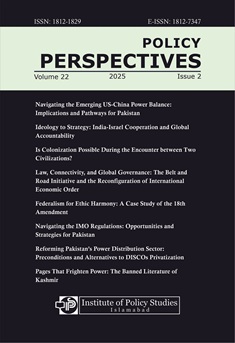
Policy Perspectives (Volume 22, Issue 2, 2025)
The latest issue of Policy Perspectives presents research, analyses, and discussion on various topics concerning national and international matters from policy experts, academics, and practitioners.
The post–Cold War international order is becoming increasingly complex as US–China rivalry intensifies across military, economic, and technological domains. Given its longstanding ties with China and US’ historically closer alignment with India, Pakistan must navigate delicate strategic choices that will influence both its own future and the stability of South Asia. In this backdrop, the Journal team convened a written symposium on ‘Navigating the Emerging US-China Power Balance: Implications and Pathways for Pakistan’, taking leading foreign policy thinkers and experts on board, including: Sohail Mahmood, Sardar Masood Khan, and Zamir Akram.
Interviewees: Ambassador (r) Sohail Mahmood, Director General, Institute of Strategic Studies Islamabad (ISSI), Islamabad, Pakistan; Ambassador (r) Sardar Masood Khan, former Ambassador to the US, China and United Nations (UN) and former President of Azad Jammu and Kashmir; and Ambassador (r) Zamir Akram, former Ambassador and Permanent Representative to the United Nations (UN).
https://doi.org/10.13169/polipers.22.2.symp
Given the expanding strategic alliance between India and Israel, the paper ‘Ideology to Strategy: India–Israel Cooperation and Global Accountability’ reviews its evaluation from a transactional defense partnership to an ideologically-infused relationship. It argues that India-Israel joint defense and intelligence ventures are driven by extremist ideologies culminating in increased humanitarian crises and militarization of ideology and policy. The Indo-Israeli collaboration not only undermines regional stability, it poses challenges to Pakistan’s interests, and contributes to the global decline of accountability in the face of occupation and genocide.
Author: Asifa Tanveer, Associate Editor, Institute of Policy Studies, Islamabad, Pakistan.
https://doi.org/10.13169/polipers.22.2.ra1
The paper ‘Is Colonization Possible During the Encounter Between Two Civilizations?’ examines whether colonization can occur from civilizational encounters by comparing European and Islamic encounters with other societies. While European colonization enforced exploitative rule and cultural erasure, Islamic encounters generally encouraged pluralism, scholarship, and peaceful coexistence. Using Egypt as a case study and drawing on Schulze and Toynbee, the paper evaluates how different ideological and structural factors led to these contrasting outcomes.
Author: Shahzada Rahim Abbas, PhD Scholar, Department of Civilizational Studies, Ibn Haldun University (IHU), Istanbul, Turkey.
https://doi.org/10.13169/polipers.22.2.ra2
Amidst failing rules-based world order, the paper ‘Law, Connectivity, and Global Governance: The Belt and Road Initiative and the Reconfiguration of International Economic Order’ examines the BRI not merely as an infrastructure or development initiative, but as an evolving legal and governance paradigm aimed at restoring trust, predictability, equitability, equality of nations and cooperation in cross-border economic cooperation. Built on the foundations of mutual respect among nations, sovereignty, equality, and legal harmonization, it represents a thoughtful philosophical shift in the evolution of global governance and thus international order. It argues that the BRI’s legal architecture, reinforced by the Global Development, Security, Civilization, and Governance Initiatives, represents a shift from a contemporary power-based order toward a principled, predictable, and justice-oriented model of global governance.
Author: Khalid Rahman, Chairman, Institute of Policy Studies (IPS), Islamabad, Pakistan.
https://doi.org/10.13169/polipers.22.2.ra3
The paper ‘Federalism for Ethnic Harmony: A Case Study of the 18th Amendment’ analyzes the impact of the 18th amendment on addressing the provincial grievances that had fueled ethnic conflict in Pakistan, and by implication, its effectiveness as a tool for solving ethnic conflict, among others. It argues that Federalism in Pakistan has only been partially successful in resolving ethnic conflict as developmental inequalities persist despite the attempts to reduce them through the amendment. Moreover, the paper contends that the amendment seems to have created intra-provincial ethnic tensions. While the 18th amendment proves to be a step in the right direction, failure to address capacity issues has prevented it from achieving its intended objectives and full potential.
Author: Eman Farooq, Master’s Scholar, Bard College, New York, United States.
https://doi.org/10.13169/polipers.22.2.ra4
The next paper ‘Navigating the IMO Regulations: Opportunities and Strategies for Pakistan’ reviews Pakistan’s status under key International Monetary Fund (IMO) conventions. It explores the institutional, legal, and infrastructure barriers that hinder full implementation. It benchmarks Pakistan against regional peers, namely Bangladesh, India, Türkiye, and Vietnam with similar shipbreaking industries and strategic ports. It covers Pakistan’s maritime landscape, regulatory framework, and strategic initiatives highlighting strengths and gaps. It highlights that the fragmented governance especially after the 18th Amendment and outdated laws limit enforcement. Finally, the paper recommends harmonizing laws, upgrading ports and shipyards, strengthening institutions, and unifying blue economy policies.
Authors: Muhammad Jawad Akhtar, Former Advisor, Maritime Affairs, Ministry of Planning Development & Special Initiatives (MoPD&SI), Government of Pakistan; Senior Associate, Institute of Policy Studies, (IPS), Islamabad, Pakistan; and Muhammad Umair, Researcher, Department of Politics and International Relations, International Islamic University (IIU), Islamabad, Pakistan.
https://doi.org/10.13169/polipers.22.2.ra5
As the government follows a multi-phase privatization plan for distribution companies (DISCOs), the distribution sector in Pakistan is undergoing a significant policy shift. The paper ‘Reforming Pakistan’s Power Distribution Sector: Preconditions and Alternatives to DISCOs Privatization’ maintains that some foundational reforms are necessary prerequisites to successful privatization of DISCOs. It also explores alternative models, including performance-based management contracts and commercialization strategies to address persistent operational inefficiencies without immediate asset transfer. It underscores that in the absence of such reforms, privatization risks replicating past mistakes rather than resolving them.
Author: Faryal Qazi, MS Scholar, Department of Strategic Studies, Air University (AU), Islamabad, Pakistan.
https://doi.org/10.13169/polipers.22.2.ra6
On August 5, 2025—six years after India’s unlawful revocation of Jammu and Kashmir’s special status—the Indian government intensified its repression by forfeiting 25 books under Section 98 of the BNSS, 2023. This law allows authorities to label literature as ‘seditious’ or ‘radicalizing,’ effectively banning its possession or circulation in Kashmir and across India. The essay ‘Pages that Frighten Power: The Banned Literature of Kashmir’—the first in a series reviewing the 25 books banned on Kashmir— examines 13 of these works with the aim of highlighting voices that address questions of legality and the long-standing challenges faced by the Kashmiris.
Reviewers: Malik Waleed, Researcher, Institute of Policy Studies (Islamabad), Pakistan; Waleed Rasool, PhD, Executive Director, Institute of Multi-Track Dialogue, Development and Diplomatic Studies (IDDS), Islamabad, Pakistan; Tayyaba Khurshid, Research Officer, Center for International Strategic Studies (CISS), Muzaffarabad, Azad Jamuu and Kashmir (AJK), Pakistan; Waqas Khan, PhD, Head of Department of Islamic Studies at Riphah International University, Islamabad, Pakistan; Usama Hameed, Research Associate, India Study Centre, Institute of Strategic Studies Islamabad (ISSI), Islamabad, Pakistan; Altaf Hussain Wani, Chairman, Kashmir Institute of International Relations (KIIR), Islamabad, Pakistan; Adnan Sarwar Khan, PhD, Former Head of Department, International Relations, National University of Modern Languages (NUML), Islamabad, Pakistan; Farzana Yaqoob, Former Minister for Social Welfare and Women Development, Azad Jammu and Kashmir; Founding Member of the Asia Institute of Public Policy; Aneela Shahzad, Geopolitical Analyst; Author of the books: Understanding Politics; Geopolitics— From the Other Side; and Geopolitics – Frameworks and Dynamics in a Multipolar World; Iftikhar Gilani, Independent Journalist; and Saba Ghulam Nabi, Research Officer, Center for International Strategic Studies (CISS), Muzaffarabad, Azad Jamuu and Kashmir (AJK), Pakistan.
https://doi.org/10.13169/polipers.22.2.re1
The full text of the articles is available at ScienceOpen.




Editorial Office: journal-pp@ips.net.pk