IPS Session Highlights Strategic Writing for Effective Digital Advocacy
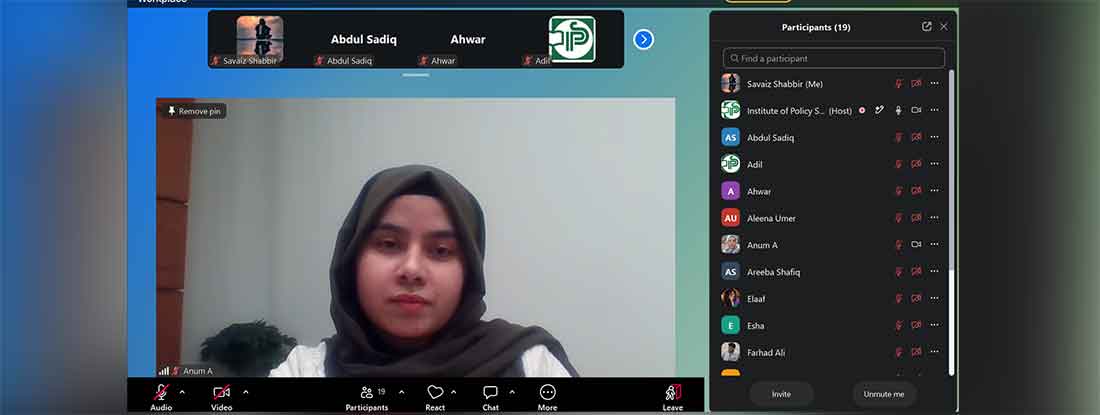
The Institute of Policy Studies (IPS), Islamabad, organized an online session titled “From Narrative to Influence: Strategic Writing for Digital Advocacy,” on October 21, 2026, under its Digital Advocacy Program, featuring Anum Akhlaq, Advocacy and Communication Officer at the National Emergency Operations Centre, Polio Eradication Initiative, as the guest speaker.
In her opening remarks, Saba Maarif, Assistant Manager, Outreach, IPS, welcomed the speaker and participants. Building on the previous session’s discussion on how communication shapes perceptions, she highlighted the importance of strategic writing in digital advocacy. She noted that effective advocacy extends beyond sharing information to framing issues, developing narratives, engaging audiences, and encouraging critical thinking.
Moderator for the session, Muhammad Ehsan, Communication and Outreach Officer, IPS, introduced Anum Akhlaq, highlighting her professional experience in advocacy, communication, media engagement, and strategic messaging, including her work in coordinating advocacy strategies and crisis communication with national and provincial stakeholders.
Speaking on the practical dimensions of strategic writing, Anum Akhlaq emphasized that effective advocacy requires more than strong vocabulary or well-written content. She explained that communication must be grounded in credible evidence, audience research, and a clear understanding of the change an advocate seeks to achieve. Writers, she noted, must identify their target audience, determine who can bring about the desired change, and establish what the audience should think, feel, or do in response to a message.
She stressed that awareness is only the initial stage of advocacy, with the ultimate objective being individual and collective action. She highlighted the importance of connecting social and policy issues to their human impact and relevance, explaining that audiences are more likely to engage with issues when they understand how these affect their lives and communities.
Using international advocacy campaigns, including the International Campaign to Ban Landmines, she illustrated how evidence-based narratives and humanitarian framing can generate public support and influence policy decisions. She also discussed the importance of clear core messages, compelling headlines, effective captions, and platform-specific communication strategies. She noted that communication should be tailored to the intended audience, as different platforms serve different purposes and stakeholder groups.
Emphasizing the need for consistency across digital platforms, Anum Akhlaq explained that collective action cannot be achieved through a single message but requires sustained, coordinated communication. She also underscored the importance of ethical storytelling, credible data, and interpreting information in ways that make its significance clear to audiences.
The session concluded with a recap of key principles of strategic writing and digital advocacy, highlighting the need to move beyond describing what is happening to explaining why it matters and what action should follow.