Pakistan’s maritime future depends on regional cooperation and secure sea lanes: IPS discussion
Growing instability around key maritime chokepoints is reshaping regional security dynamics and compelling countries to rethink traditional approaches to maritime defence. As disruptions in the Strait of Hormuz and Bab-el-Mandeb continue to threaten global trade and energy flows, regional states are increasingly exploring cooperative security arrangements to safeguard strategic waterways and ensure freedom of navigation. For Pakistan, whose maritime territory exceeds the combined size of three provinces and whose economy depends heavily on secure sea routes, maritime awareness and regional cooperation are becoming critical components of national security.
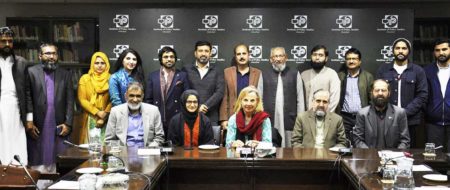
These themes dominated a discussion session titled “National Maritime Defence Alliance: Significance for the Region and Beyond,” organized by the Institute of Policy Studies (IPS), Islamabad, on August 6. The keynote address was delivered by Rear Admiral (r) Syed Faisal Shah, recipient of the Sitara-i-Imtiaz (Military) and Hilal-i-Imtiaz (Military). The discussion session was hosted by Chairman IPS, Khalid Rahman.
Opening the discussion, participants highlighted the strategic importance of the newly announced Saudi-led multinational maritime defence alliance, which includes fourteen countries and aims to secure the Red Sea, the Bab-el-Mandeb Strait, and the Gulf of Aden. The alliance seeks to protect maritime trade, energy supplies, and freedom of navigation amid growing regional tensions and disruptions in global supply chains.
Addressing the gathering, Rear Admiral Shah emphasized that maritime affairs remain an underexplored area in Pakistan despite the country’s vast coastline and strategic location. He argued that the recent crisis surrounding the Strait of Hormuz has reaffirmed the enduring importance of geography in international politics, challenging the widespread belief that technological advances have diminished the strategic value of physical location. According to him, the confrontation demonstrated that geography can still constrain even the most powerful states and significantly shape military and political outcomes.
The discussion underscored that shipping routes depend not only on military capabilities but also on perceptions of security. Participants observed that, despite the deployment of international naval forces in recent years, many shipping companies continued to avoid vulnerable waterways, opting instead for longer and more expensive routes around Africa. The episode, speakers noted, highlighted the decisive role of strategic chokepoints in global commerce.
Rear Admiral Shah argued that the crisis has also accelerated the emergence of new regional security arrangements. He described the Saudi-led maritime coalition as the first step toward broader security mechanisms designed to protect critical sea lanes and reduce dependence on external powers. He maintained that regional states increasingly recognize the need to take greater responsibility for their own security while preserving stability in strategically vital waters.
Discussing Pakistan’s role, Shah noted that among the fourteen participating navies, Pakistan, Saudi Arabia, Turkey, and Egypt possess the most substantial maritime capabilities. Owing to its extensive operational experience, longstanding cooperation with international maritime forces, and active participation in regional security patrols, Pakistan is well positioned to contribute significantly to the alliance’s future development.
Responding to a question regarding the implications of Pakistan’s participation for its relations with Iran, Shah emphasized that international relations are shaped by national interests rather than personal considerations. He observed that Pakistan seeks to maintain balanced relations with all regional actors while conveying that instability in the region threatens the interests of all neighboring countries.
Participants observed that the future of the alliance remains uncertain and that its long-term significance will depend on whether it evolves into a permanent regional security framework or remains a temporary response to immediate maritime challenges. Nevertheless, they agreed that the changing geopolitical environment has made maritime security an increasingly important pillar of regional stability and global economic resilience.
In his concluding remarks for the session, Khalid Rahman observed that the rapidly changing geopolitical environment requires an understanding of the connections between regional and global developments, from Gaza to the Strait of Hormuz. He noted that shifting perceptions and declining moral authority are reshaping international politics and emphasized that durable peace depends on an inclusive regional security framework. He also underscored the importance of preserving indigenous languages and intellectual traditions.