The Living Scripts Sessions with Ambassador (r) Aizaz Ahmad Chaudhry
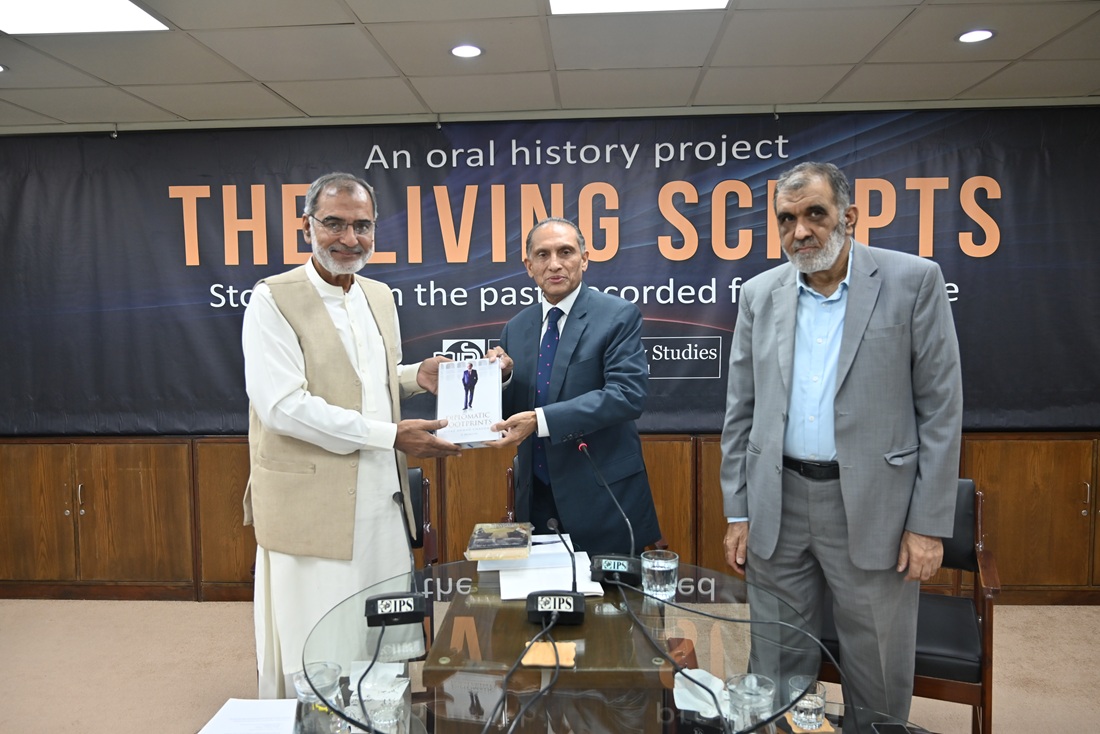
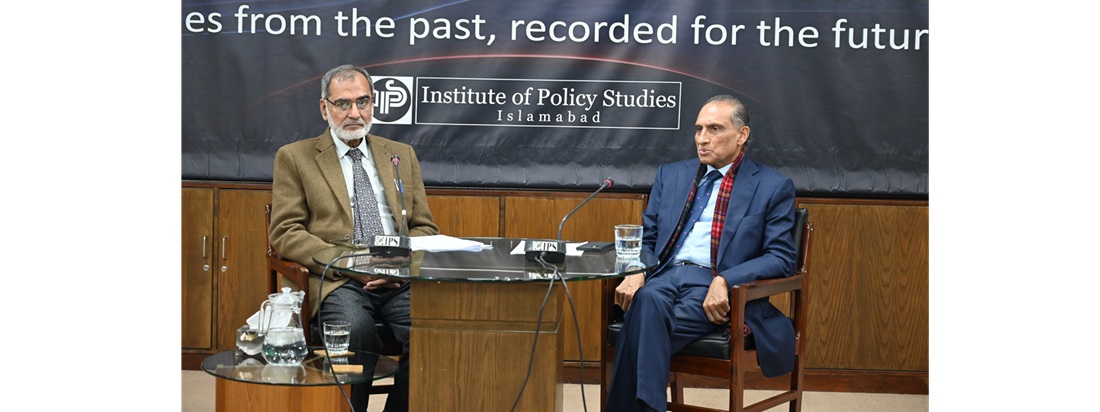
The 39th session of IPS’s oral history project, The Living Scripts, featured Ambassador Aizaz Ahmad Chaudhry, former Foreign Secretary of Pakistan. The conversations were held on October 27, 2025, and January 8 and 29, 2026, during which Ambassador Chaudhry revisited the milestones of his life and diplomatic career, sharing memories, reflections, and personal anecdotes.
Recalling his early years, Ambassador Chaudhry spoke warmly about his upbringing and education. Born on February 27, 1958, he began his academic journey at PAF College Sargodha, an institution he credited for shaping his discipline, confidence, and leadership skills. He reflected on his student days at the University of the Punjab, Lahore, where he pursued Bachelor’s and Master’s degrees in Political Science between 1978 and 1982. Later, his quest to better understand global affairs took him to the Fletcher School of Law and Diplomacy at Tufts University, where he completed a Master’s in International Relations in 1990, a period he described as intellectually transformative.
Ambassador Chaudhry shared vivid memories of joining the Foreign Service of Pakistan in 1980. He recalled the rigor of training at the Civil Service Academy in Lahore and the Foreign Service Training Institute in Islamabad, experiences that introduced him to the demands and responsibilities of diplomatic life. His early postings, including language training in Cairo and assignments in Doha, Qatar, as Third and later Second Secretary, exposed him to the complexities of Middle Eastern politics. He reminisced about how these formative years helped him develop a nuanced understanding of diplomacy and multilateral engagement.
Reflecting on his return to Islamabad in 1988, he narrated his experiences working at the Ministry of Foreign Affairs and later his six-year tenure in Tehran as Chef de Cabinet to the Secretary General of the Economic Cooperation Organization (ECO). He described the 1990s as an extraordinary period in world history, the end of the Cold War, the breakup of the Soviet Union, and the emergence of Central Asian states. Ambassador Chaudhry recalled witnessing firsthand how ECO evolved during this time, expanding its membership and ambitions, and how regional cooperation became both a challenge and an opportunity.
He recounted his return to Pakistan in 1997 as Chef de Cabinet to the Foreign Secretary, a period marked by intense regional developments. Sharing personal insights from behind-the-scenes diplomacy, he spoke about high-level engagements with India and the tense atmosphere surrounding Pakistan’s nuclear tests in 1998. Ambassador Chaudhry reflected on the pressures of that time (international sanctions, economic uncertainty, and strategic dilemmas), recalling how policymakers grappled with decisions they believed were essential for maintaining regional balance.
His years at Pakistan’s Permanent Mission to the United Nations in New York from 1999 to 2006 were among the most eventful of his career. He vividly remembered being at the UN during the September 11 attacks and the dramatic shifts that followed in global politics. He shared anecdotes about late-night negotiations, emergency Security Council meetings, and Pakistan’s challenging role as a frontline state in the War on Terror. Those years, he noted, taught him the true meaning of multilateral diplomacy under pressure.
Returning to Islamabad in 2007, Ambassador Chaudhry recalled leading Pakistan’s engagement with the Organization of Islamic Cooperation (OIC). He spoke about chairing OIC meetings and helping organize the OIC Conference of Foreign Ministers in Islamabad in May 2007. He described this period as one in which Pakistan sought to present itself as a bridge between the Muslim world and the West. Later, as Director General (South Asia), he reflected on the complexities of regional diplomacy and his experiences representing Pakistan at SAARC forums.
His posting as Ambassador to the Netherlands from 2009 to 2012 was, in his words, a different but deeply rewarding chapter. He fondly remembered engaging with European audiences and attempting to present a balanced image of Pakistan. It was during this time that he authored Pakistan Mirrored to Dutch Eyes, a project he described as an effort to understand how Pakistan was perceived abroad and how those perceptions could be reshaped.
Ambassador Chaudhry went on to share recollections from his later roles in Islamabad, first as Additional Foreign Secretary in 2012, overseeing relations with the United Nations and international organizations, and then as spokesperson for the Ministry of Foreign Affairs in 2013. He described this as a particularly demanding phase, requiring careful communication at a sensitive time in Pakistan’s foreign relations.
Perhaps most reflectively, he spoke about his tenure as Foreign Secretary from December 2013 to March 2017, a position he described as the pinnacle of his professional life. He recounted the weight of responsibility that came with leading Pakistan’s diplomatic machinery and navigating complex relationships with major powers. His subsequent appointment as Pakistan’s Ambassador to the United States, he noted, was both a challenging and enriching experience, filled with moments that tested his patience, resolve, and diplomatic skill.
Bringing the sessions to a close, Ambassador Chaudhry emphasized lessons drawn from decades of service, particularly the need for strategic foresight, institutional teamwork, and continuity in foreign policy. Looking back on the events he had lived through, especially those of the turbulent 1990s, he reflected that history offers enduring guidance for the challenges Pakistan faces today.
Through his stories, insights, and candid recollections, the sessions offered a rare glimpse into the life of a diplomat who witnessed and helped shape some of the most significant moments in Pakistan’s recent history.