The Living Scripts Session with Ambassador Moin ul Haque
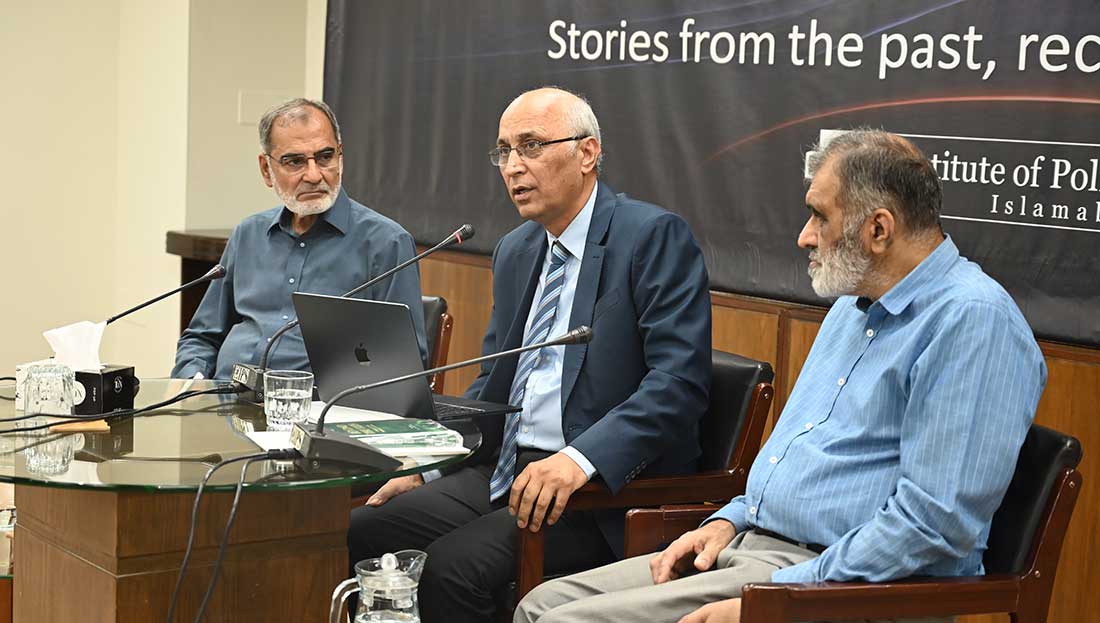
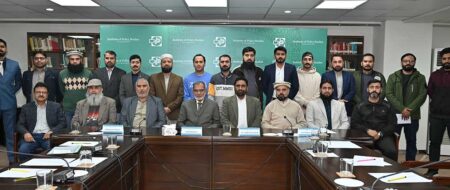
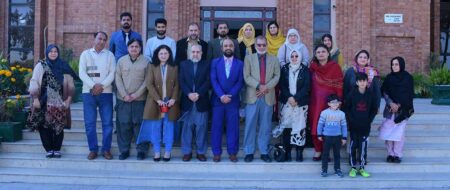
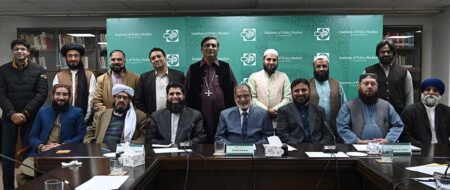
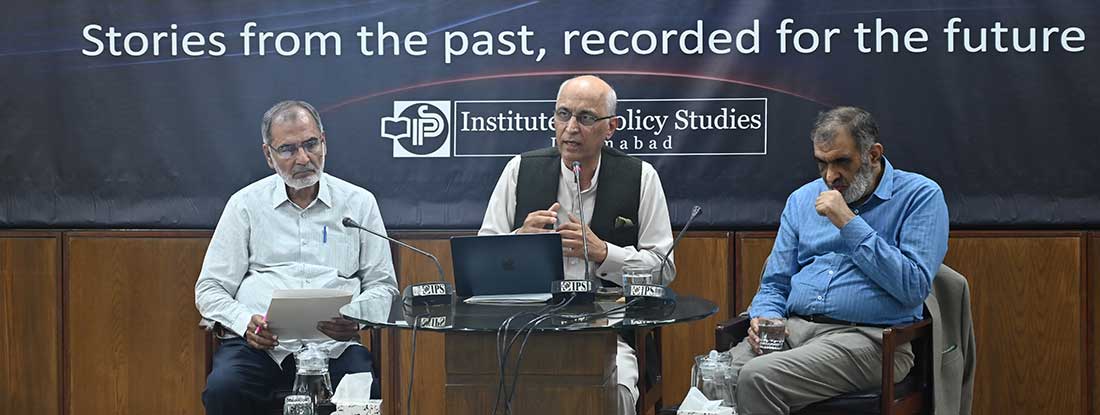
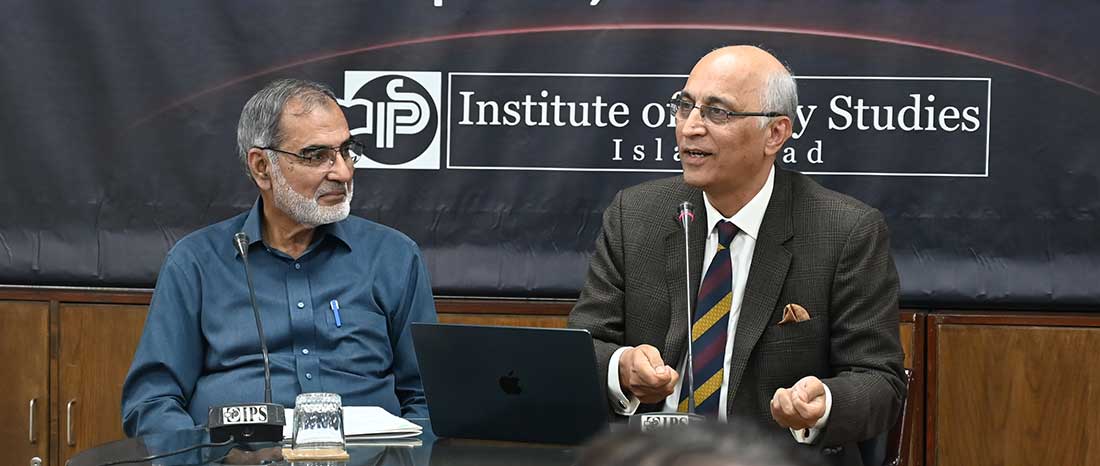
The 38th session of IPS’ oral history project, The Living Scripts, was held with Ambassador (r) Moin ul Haque, Ambassador Extraordinary and Plenipotentiary of the Islamic Republic of Pakistan to the People’s Republic of China. The sessions were held on October 15, October 23, and November 18, 2025.
Ambassador Haque, a distinguished career diplomat from the 1987 batch of the Foreign Service of Pakistan, shared candid reflections on his diplomatic journey, major foreign postings, and the evolving dimensions of Pakistan–China relations.
He was born in Rawalpindi on March 01, 1963, and joined the Foreign Service on November 14, 1987, after completing his M.Com degree. During his career at the Ministry of Foreign Affairs, he served in several key roles, including desk officer for Bangladesh, assistant director in the Personnel Division, deputy director at the OIC Summit Cell and the Foreign Secretary’s Office, director in the Foreign Secretary’s Office, director general for Europe, chief of protocol, and additional secretary (administration). These roles placed him at the center of high-level international engagements and important institutional reforms.
Sharing his memories from the Protocol Division, he recalled serving as Pakistan’s chief of protocol for two years, overseeing major official visits, including the landmark visit of the President of China to Pakistan in April 2015, which gave a major boost to the Pakistan–China relationship. He also accompanied then Prime Minister Nawaz Sharif on official visits to Norway and France during this period.
Ambassador Haque’s foreign postings took him across multiple regions. He served in Brussels (1993–1996), at Pakistan’s Permanent Mission to the United Nations in New York (1999–2002), in Colombo (2002–2005), as consul general in Vancouver (2007–2010), and as deputy head of mission in Ankara (2010–2013).
In July 2016, he became Pakistan’s Ambassador to France, concurrently accredited to Monaco and serving as Pakistan’s permanent delegate to UNESCO. He described this period as both significant and challenging, having witnessed the Paris and Nice terrorist attacks firsthand and experiencing a temporary diplomatic slowdown caused by the India–France aircraft deal. Despite these constraints, he actively promoted Pakistan’s tourism potential by inviting French tour operators and helping develop organized tourism packages. He also hosted an international conference at UNESCO showcasing Pakistan’s cultural and educational strengths.
Ambassador Haque served as Pakistan’s Ambassador to China from August 2020 to 2023, a role he described as a “monumental responsibility” given the depth of Pakistan–China cooperation. Speaking at length about China, he highlighted three important aspects of China, i.e., its governance system, the foundations of its rapid economic rise, and its long-standing friendship with Pakistan. He noted that China’s historically peaceful posture and its transformation under Deng Xiaoping laid the basis for several decades of high economic growth. Today, he said, China leads the world in exports, electric vehicles, solar energy, drones, e-commerce, and high-speed rail, and has lifted over 800 million people out of poverty.
He attributed China’s success to strong state focus, civilizational continuity, long-term policy stability, investment in human capital, decentralized governance, and a dynamic private sector. He added that national discipline, unity, and leadership rooted in values played a defining role, remarking that “a true leader leads by virtue, not by force.”
Discussing Pakistan–China relations, he described the two countries as “iron brothers,” noting that China has consistently stood by Pakistan since the 1960s. He highlighted the progress of CPEC, noting that Phase I focused on infrastructure, while Phase II is now emphasizing industrial development, agriculture, IT cooperation, and defense collaboration. He mentioned that China has also provided advanced defense equipment to Pakistan, including aircraft, frigates, and submarines. Cultural ties between the two nations continue to grow, with a significant Pakistani community living in China and an increasing number of Chinese universities teaching Urdu.
Having traveled widely across China, Ambassador Haque expressed his firm belief that Pakistan’s future in investment, technology, agriculture, and industrial development is closely tied to China.
He is proficient in English, Urdu, and French and has been awarded the Sitara-e-Imtiaz for his services to Pakistan.