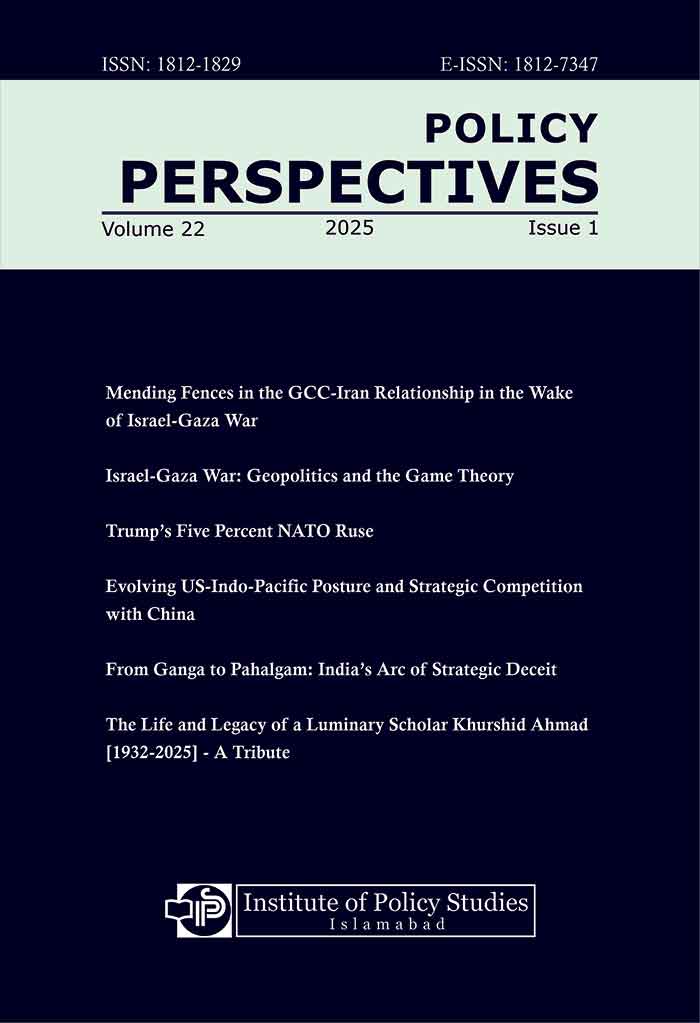
Policy Perspectives (Volume 22, Issue 1, 2025)
Editor-in-Chief: Khalid Rahman Download Contents |
Policy Perspectives (Volume 22, Issue 1, 2025)
The latest issue of Policy Perspectives presents research, analyses, and discussion on various topics concerning national and international matters from policy experts, academics, and practitioners.
Amid the ongoing war in Gaza, the Gulf Cooperation Council (GCC) appears to share more foundational ties with Iran than with Israel, prompting a comprehensive reassessment of the GCC relations and regional alignments. Employing the prisoner’s dilemma framework, Dr Nora Maher in her paper “Mending Fences in the GCC-Iran Relationship in the Wake of Israel-Gaza War” examines how hardline Gulf states could shift from a punitive stance toward Iran to a collaborative approach, encouraging cooperation over confrontation.
Author: Dr Nora Maher, Assistant Professor, Political Science, Political Science Department, Faculty of Political Science, Economics and Business Administration, May University, Cairo, Egypt.
https://doi.org/10.13169/polipers.22.1.ra1
The Palestine-Israel ‘game’ is a multitier, intricate, and ever-evolving conflict, shaped by complex geopolitical dynamics. The paper on “Israel-Gaza War: Geopolitics and the Game Theory” evaluates the protracted Israel-Palestine conflict through the lens of game theory,and seeks to lay down the field of play, identify players, discover different angles from which to approach the matter, and bring the reader closer to possible solutions.
Author: Aneela Shahzad, Geopolitical Analyst; Author of the books: Understanding Politics; Geopolitics— From the Other Side; and Geopolitics – Frameworks and Dynamics in a Multipolar World.
https://doi.org/10.13169/polipers.22.1.ra2
Lars Hilse in his paper “Trump’s Five percent NATO Ruse” assesses President Donald Trump’s demand for North Atlantic Treaty Organization (NATO) members to contribute five percent of the Gross Domestic Product (GDP), as a strategic business initiative rather than a genuine security policy objective. The paper argues that President Trump’s demand strategically advances American business interests, as the European nations currently allocate approximately 63 percent of their military procurement budgets to US defense firms, yielding a substantial return on minimal US investment in NATO’s actual operational costs.
Author: Lars Hilse, Independent Researcher, Cyber Security Expert, Bunsoh, Germany.
https://doi.org/10.13169/polipers.22.1.ra3
Historically, the U.S. Indo-Pacific policy has been shaped by efforts to counter China’s expanding political, economic, and military influence. China’s territorial claims in the South China Sea (SCS) and East China Sea (ECS), along with its tensions with Taiwan and US regional allies, have prompted Washington to recalibrate its Indo-Pacific policy and strategic posture. The paper “Evolving US Indo-Pacific Posture and Strategic Competition with China” also analyzes the political, economic and military ramifications of the US Indo-Pacific policy for China including regional alliances, trade and investments, arms race, maritime security, tariffs and duties under Trump 2.0 administration.
Authors: Abid Hassan, Research Associate, Department of IR, International Islamic University, Islamabad, Pakistan; and Syed Hammad Ali, Research Associate, Department of IR, International Islamic University, Islamabad, Pakistan
https://doi.org/10.13169/polipers.22.1.ra4
Asifa Tanveer in her paper on “From Ganga to Pahalgam: India’s Arc of Strategic Deceit” evaluates India’s tendency to blame Pakistan for its domestic instabilities, particularly ‘terrorist’ events. She explores the history and use of false flag operations to contextualize India’s pattern of blame provenance in the wake of Pahalgam incident. She further analyzes whether Pahalgam incident and the much-hyped Indian response reflects honest concerns, or a broader political agenda, reflecting ‘method in madness’.
Author: Asifa Tanveer, Associate Editor, Institute of Policy Studies (IPS), Islamabad; Former Chief Officer, Local Government & Community Development Department (LGCDD), Rawalpindi, Pakistan.
https://doi.org/10.13169/polipers.22.1.ra5
Next, Khalid Rahman in his paper “The Life and Legacy of A Luminary Scholar Khurshid Ahmad (1932-2025): A Tribute” pays homage to Prof. Khurshid Ahmad, the founder and patron of the Policy Perspectives, exploring his contributions. Khurshid Ahmad was not only a prominent Pakistani figure and global thought leader, but also a staunch ambassador of Islamic thought, Pakistan and the Muslim Ummah, earning him widespread respect, even from across ideological and political divides. His writings and initiatives, which explain the distinction between Islamic economics, socialism, and capitalism, helped shape modern Islamic economic theory, he argues.
Author: Khalid Rahman, Chairman, Institute of Policy Studies (IPS), Islamabad, Pakistan
https://doi.org/10.13169/polipers.21.2.ra6
Finally, the ‘Dialogue at IPS’ section features discussions of events held at the Institute of Policy Studies on a number of significant subjects related to national, regional and global affairs during recent months along with a summary of situational briefs on ‘Beyond the Frontlines: 50 Days since Pahalgam Incident’.
The full text of the articles is available at ScienceOpen.