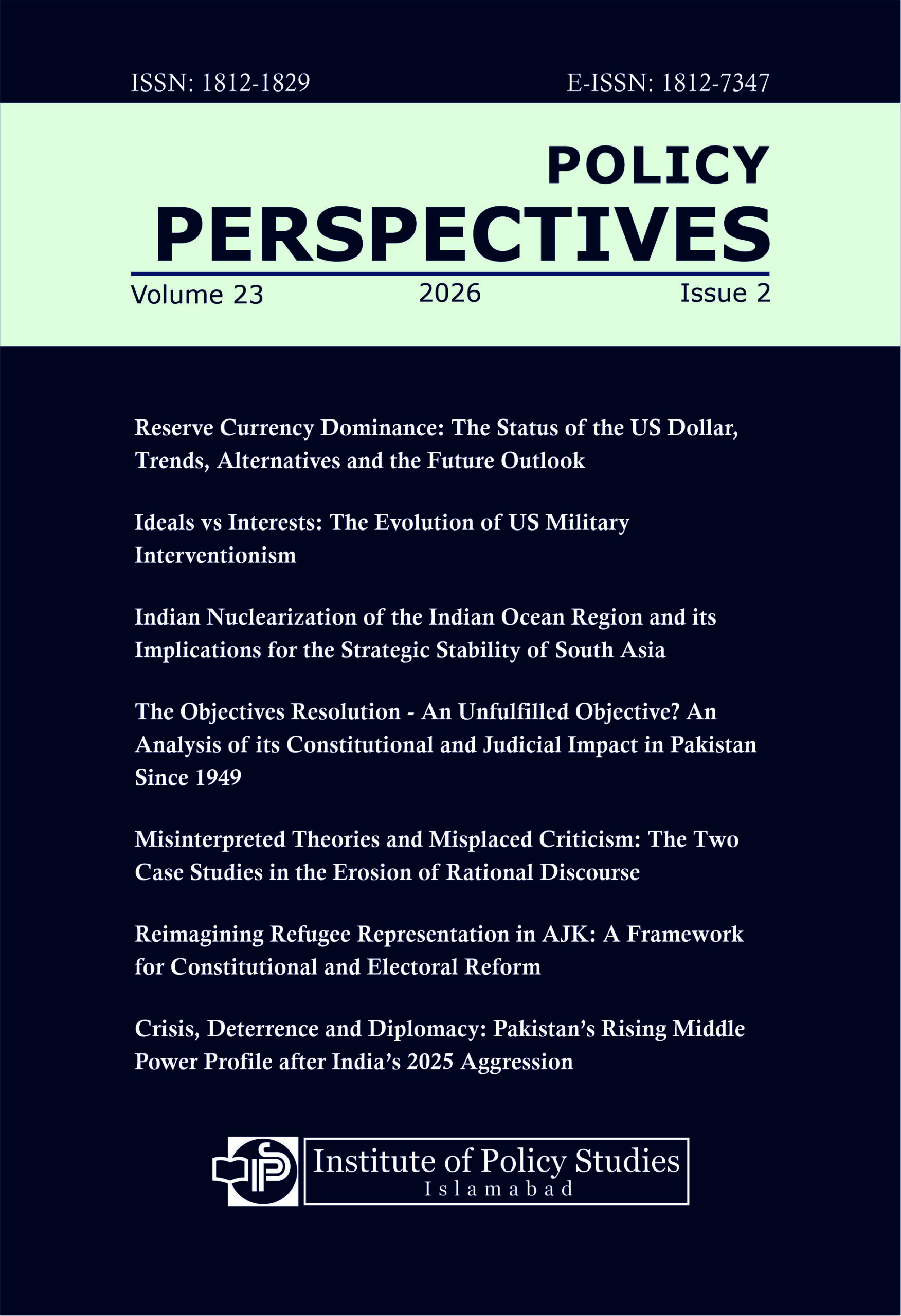
Policy Perspectives (Volume 23, Issue 2, 2026)
 |
Editor-in-Chief: Khalid Rahman Editor: Prof Dr Fakhr-ul-Islam Retail Price (Pak): PKR600 Annual Subscription: PKR1000 Export Price: $60 (per copy) Annual International Subscription: $120 Download Contents |
About the Issue
The latest issue of Policy Perspectives presents research, analyses, and discussion on various topics concerning national and international matters from policy experts, academics, and practitioners.
Amjad Maqsood in his paper “Reserve Currency Dominance: The Status of the US Dollar, Trends, Alternatives and the Future Outlook” explores the historical evolution of international reserve currencies, the emergence and resilience of the US dollar-centered monetary order, and the prospects for future change. He traces the transition from earlier reserve currencies to the US dollar and elucidates the institutional, financial, and geopolitical foundations of its persistent dominance. Maqsood further examines the growing demand for reserve diversification driven by geopolitical tensions, sanctions, debt vulnerabilities, and strategic competition. Finally, he evaluates the evolving international role of the Chinese renminbi and other emerging alternatives, including gold and digital monetary innovations.
Author: Amjad Maqsood, Non-Resident Associate, Institute of Policy Studies (IPS), Islamabad, Pakistan; Economist, Ontario, Canada.
https://doi.org/10.13169/polipers.23.2.ra1
The next paper “Ideals vs Interests: The Evolution of US Military Interventionism” maintains that while the United States (US) was founded on the principles of liberty, human rights and self-determination, its military interventions over the years reflect strategic interests that contradict its founding ideals. This gap between policy rhetoric and policy practice becomes obvious as the US emerged first as a regional power and then as a global hegemon. To probe consistency or deviations between the country’s founding values and its policymakers’ actual motivations, the paper seeks to understand why and how the US wars, over decades, contradict its founding ideals, and what constitutes the reasons behind the persistence of such contradictions.
Author: Malik Waleed, Research Officer, Institute of Policy Studies (IPS), Islamabad, Pakistan.
https://doi.org/10.13169/polipers.23.2.ra2
India’s growing naval nuclearization has increased crisis instability while fueling an arms race in the region. Anwarul Haq in his paper “Indian Nuclearization of the Indian Ocean Region and its Implications for the Strategic Stability of South Asia” appraises the Indian naval nuclear modernization through the lens of offensive realism. He identifies three recurring patterns in India’s maritime behavior: capability expansion beyond stated minimalism, a doctrinal shift towards regional dominance, and a regional security narrative rooted in being a net security provider. He cautions that India’s naval nuclear posture, while increasing the risk of inadvertent escalation, could transform the region into a theatre of the global Great Game.
Author: Anwarul Haq, Research Scholar, Department of International Relations, National University of Modern Languages (NUML), Islamabad.
https://doi.org/10.13169/polipers.23.2.ra3
The Objectives Resolution, passed by Pakistan’s first Constituent Assembly on March 12, 1949, has served as the symbolic core of Pakistan’s constitutional journey. From the Darshan Masih Case to numerous suo moto cases before the courts today, the Objectives Resolution has exerted a profound influence on how fundamental rights are perceived and adjudicated. Despite its central role as a constitutional grundnorm, its impact has received insufficient scholarly attention, resulting in a fragmented and often confusing understanding of its significance. The paper “The Objectives Resolution – An Unfulfilled Objective? An Analysis of Its Constitutional and Judicial Impact in Pakistan Since 1949” seeks to examine the true constitutional importance of the Objectives Resolution, its influence on the jurisprudence of Pakistan’s courts, and its continuing relevance to future constitutional debates and developments in Pakistan.
Author: Syed Muaz Shah, LLM International Law, Geneva Graduate Institute, Geneva, Switzerland; Quran Covenant Research Center, Islamabad, Pakistan; Centre for Islamic Law & Human Rights, Karachi, Pakistan.
https://doi.org/10.13169/polipers.23.2.ra4
In academic and intellectual discourse, disagreement with scientific theories is not only expected but often encouraged as part of the pursuit of knowledge. However, in certain cultural contexts, such disagreements can take on a personal and confrontational tone, where academics advocating for or against a theory become targets of coercion or ad hominem attacks. Dr Farhat Taj in her paper “Misinterpreted Theories and Misplaced Criticism: The Two Case Studies in the Erosion of Rational Discourse” navigates the challenges to scientific discourse in Pashtun academic and cultural contexts in Pakistan through two cases: the coercion of a Zoology assistant professor in Bannu district to renounce Darwin’s theory of evolution and a podcast discussion critiquing a peer-reviewed article on Pakistan-Afghanistan relations. While these cases are not representative of broader trends in the country, they provide some insights into how scientific dialogue can be constrained by geopolitical, linguistic, and cultural factors, Taj contends.
Author: Dr Farhat Taj, Associate Professor, University of Tromsø, UiT The Arctic University of Norway, Norway.
https://doi.org/10.13169/polipers.23.2.ra5
The controversy over 12 refugee seats in the Azad Jammu and Kashmir (AJK) Legislative Assembly has drawn renewed attention to the constitutional and political challenges of refugee representation in AJK, particularly in light of the demands raised by the Joint Awami Action Committee (JAAC). Although it appears to concern electoral representation, the issue raises broader questions about AJK’s constitutional identity, Pakistan’s position in the wider Jammu and Kashmir dispute, the rights of displaced populations, and the future of democratic legitimacy in Muzaffarabad. Given the constitutional, political, and historical realities, the paper “Reimagining Refugee Representation in AJK: A Framework for Constitutional and Electoral Reform” assesses alternative options to ensure refugee representation within the AJK legislative framework without undermining the political rights of local people in AJK.
Author: Iftikhar Gilani, Senior Kashmiri Journalist, who covered Kashmir in New Delhi for over three decades, is now based in Ankara, Turkey.
https://doi.org/10.13169/polipers.23.2.ra6
Dr Waleed Rasool in his paper “Crisis, Deterrence and Diplomacy: Pakistan’s Rising Middle Power Profile after India’s 2025 Aggression” analyzes how India’s May 2025 military aggression, named as Operation Sindoor, became a strategic catalyst that elevated Pakistan’s geopolitical profile and consolidated its emergence as an emerging middle power despite clear asymmetry in conventional military and economic capabilities. Drawing on neoclassical realism and middle power theory, he evaluates the proposition that material parity is not a prerequisite for strategic advantage; rather, political will, resilience, calibrated restraint, and effective strategic balancing can offset power differentials. His findings demonstrate that Pakistan’s crisis management denied India escalation dominance while simultaneously enhancing Pakistan’s diplomatic leverage across major power centers. Rasool argues that Islamabad’s multi-alignment posture reflects classic middle-power behavior: autonomy preservation, soft balancing, and bridge diplomacy under systemic pressure.
Author: Dr Waleed Rasool, Executive Director, Institute of Multi-Track Dialogue, Development and Diplomatic Studies (IDDS), Islamabad, Pakistan.
https://doi.org/10.13169/polipers.23.2.ra7
The full text of the articles is available at ScienceOpen.